
Soundbars, Stereo Pairs, and Surround Systems: Matching Audio to Your Room
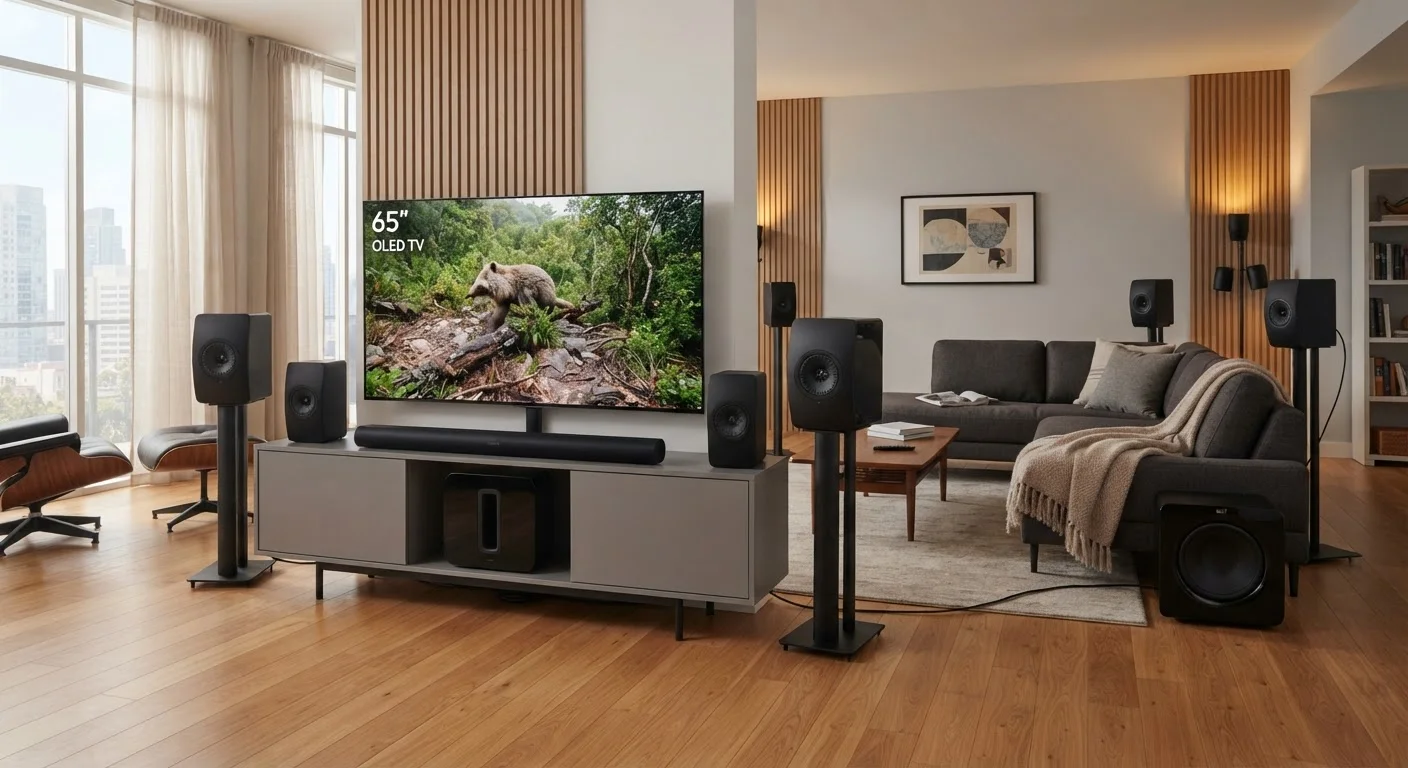
Photo credit: TheBlogZappier.com | Simple Search, Credible Results
In this article
Understand the acoustic strengths and limitations of soundbars, two-channel stereo, and multi-speaker surround setups.
Key Takeaways
- Soundbars are compact and simple but rely on acoustic tricks to simulate surround sound.
- Stereo pairs deliver natural, accurate sound and suit music-focused listeners with moderate room sizes.
- Multi-speaker surround systems offer the most immersive experience but require thoughtful room planning.
- Room size, shape, and furnishings significantly affect which format performs best in practice.
- No single format wins universally — the right choice depends on your primary use case and space.
Why Format Matters Before Brand or Price
Most audio-buying conversations jump straight to specs — wattage, driver count, frequency response. But the format you choose (soundbar, stereo pair, or surround system) determines how sound physically moves through your room before any of those numbers come into play.
Each format makes different assumptions about your space. A soundbar assumes you're sitting directly in front of a TV in a relatively compact room. A stereo pair assumes you can position two speakers symmetrically on either side of a listening area. A surround system assumes you can place speakers behind and beside you as well. Get the format wrong for your room, and no amount of EQ adjustment will fix the mismatch.
Before evaluating any specific system, it helps to understand how your room's physical properties shape what you hear. Parallel walls, hard floors, and bare surfaces all affect sound in ways that interact differently with each format.
Soundbars: Convenience With Acoustic Compromises
A soundbar consolidates multiple drivers into a single horizontal enclosure, typically mounted below or above a TV. Its main appeal is simplicity — one box, one cable to the TV, done. For viewers in apartments or smaller living rooms, that trade-off often makes sense.
The limitation is physics. Surround sound requires sound to arrive at your ears from multiple directions. Soundbars attempt to simulate this using psychoacoustic processing — techniques that bounce sound off walls or use signal timing tricks to create a sense of width. These methods work reasonably well in small, reflective rooms, but in larger or heavily furnished spaces, the effect collapses quickly.
Soundbars with dedicated satellite speakers or upward-firing drivers (for height channels in Dolby Atmos content) close some of that gap, but they also add complexity that erodes the format's simplicity advantage.
Simulated Surround Is Not True Surround
Soundbars marketed with Dolby Atmos or DTS:X support often deliver a processed approximation of those formats, not the full multi-speaker experience. The psychoacoustic techniques involved can create an impression of width, but they depend heavily on room reflections and listening position. In large or acoustically dampened rooms, the effect may be barely noticeable.
For music listening, a soundbar's single-axis design makes true stereo imaging — the sense that instruments occupy distinct positions in space — difficult to achieve. If music is a priority alongside TV audio, a stereo pair will consistently outperform a soundbar of comparable price.
Stereo Pairs: Accuracy for Music and Mid-Sized Rooms
Two-channel stereo — a left speaker and a right speaker — is the format that recorded music is almost universally mixed and mastered for. When a stereo pair is placed correctly, it creates a convincing phantom center image and a stable soundstage that a soundbar's processing can only approximate.
Placement matters significantly here. The classic equilateral triangle setup — where listener distance matches the distance between speakers — is a good starting point. Common placement mistakes, like pushing speakers flush against walls or into enclosed shelves, can undermine even capable hardware.
Stereo also gives you flexibility in system design. You can pair passive speakers with a separate amplifier, or choose active (powered) speakers that contain their own amplification. Understanding the difference between passive and active speakers affects both cost and how easily you can upgrade components over time.
Start With Your Listening Position
Before deciding on a format, sit in your usual viewing or listening spot and observe what's around you. Note the distance to the nearest walls, whether the room is open or enclosed, and how much furniture is present. Hard, bare surfaces reflect sound aggressively; soft furnishings absorb it. Both extremes affect which format will behave predictably in your space.
For movie watching, stereo is a reasonable compromise in rooms too small for surround. Most streaming services and Blu-ray players can downmix multi-channel audio to two channels without significant loss of dialogue clarity.
Surround Systems: Immersion When the Room Supports It
A full surround system — typically 5.1 (five speakers plus a subwoofer) or 7.1 — places audio sources around the listener. Dialogue comes from a center channel in front; ambient and directional effects arrive from side and rear speakers; bass is handled by a dedicated subwoofer. The result, in a well-treated room, is genuinely three-dimensional sound that no two-channel format can replicate for film and game content.
The catch is that surround systems are sensitive to room geometry. Speaker-to-listener angles, distance symmetry, and room reflections all affect whether the surround effect feels coherent or confused. Automated room correction tools (built into most AV receivers) help calibrate for your specific space, but they work best when speaker placement is already reasonable.
| Soundbar | Stereo Pair | Surround System (5.1+) | |
|---|---|---|---|
| Setup complexity | Low — single unit | Moderate — two speakers + amp | High — multiple speakers + receiver |
| Best room size | Small to medium | Small to large | Medium to large, dedicated rooms |
| Music performance | Limited stereo imaging | Accurate, natural soundstage | Adequate but not optimized |
| Movie/TV immersion | Simulated surround only | Good with downmix | True multi-directional audio |
| Cable/clutter impact | Minimal | Low to moderate | High without wireless modules |
| Room sensitivity | Moderate | Moderate — placement critical | High — geometry matters most |
Cable management is also a practical concern. Running speaker wire to rear positions in a furnished room requires planning, though wireless rear modules are now a supported option in many systems. For more on that trade-off, see our guide on wired vs. wireless home audio.
Surround sound is most rewarding in rooms that are purpose-built or at least acoustically manageable — think dedicated media rooms rather than open-plan living areas where sound can disperse unpredictably.
Matching Format to Your Actual Situation
The clearest way to approach this decision is to start with your room and your primary use case, not the audio format's feature list.
- Small rooms (under ~150 sq ft): A soundbar or compact stereo pair will usually fill the space adequately. Surround speaker placement becomes cramped and rear speakers end up too close to the listening position to be effective.
- Medium rooms (150–300 sq ft): Stereo pairs perform well and a 5.1 surround system becomes viable if placement allows. This is where format choice most directly reflects whether you prioritize music or film.
- Large or open-plan spaces: Surround systems can struggle with sound dispersion; stereo with a subwoofer may actually outperform an underpowered surround setup in terms of perceived bass and clarity.
Whatever format you choose, the source quality feeding it also shapes the result. Streaming bitrate and codec settings affect what audio data reaches your system in the first place — a factor worth understanding before attributing sound quality entirely to hardware.
And if you encounter common claims — that more speakers always sound better, or that a particular format is universally superior — it's worth checking those assumptions against evidence. Our article on home audio myths examines several widely held beliefs that don't hold up under scrutiny.

Author
Tech & Electronics Editorial Team
Tech & Electronics Editorial Team is the collective byline for our editorial team and contributor network. Articles published under this byline or an editorial pen name are researched, written, and reviewed according to our editorial standards for clarity, consistency, and independence before publication.
View all articles →