
The Acoustics of Your Living Room: Why Furniture and Walls Shape What You Hear
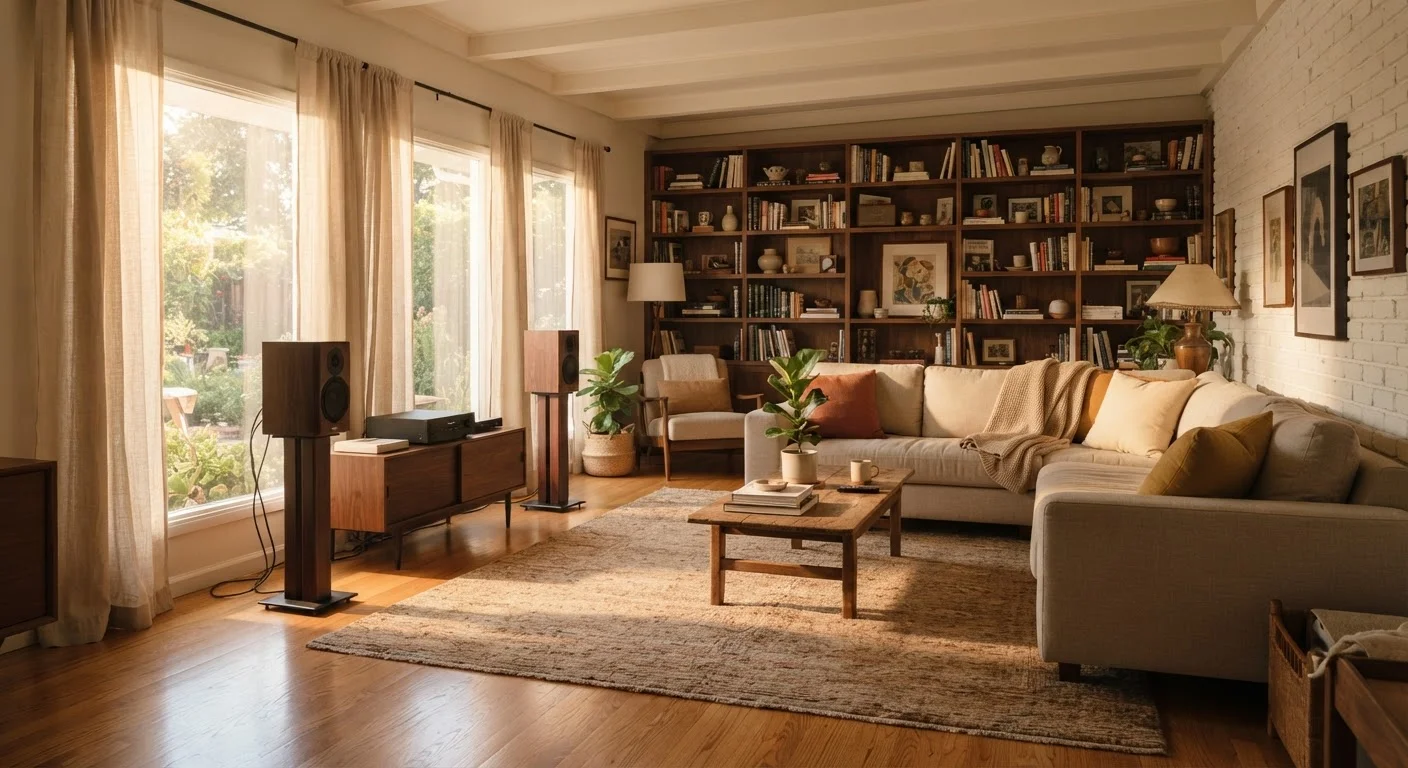
Photo credit: TheBlogZappier.com | Simple Search, Credible Results
In this article
Room size, wall materials, and furniture placement all colour your audio. Understand why, before adjusting speaker settings.
Key Takeaways
- Hard, flat surfaces like bare walls and tile floors reflect sound and add unwanted reverb.
- Soft furnishings — rugs, curtains, and upholstered sofas — absorb sound energy and reduce echo.
- Bass frequencies build up in corners and along parallel walls, causing certain notes to boom or disappear.
- Room shape and size set a physical ceiling on what any speaker or EQ setting can achieve.
- Understanding your room helps you make better decisions before touching any audio settings.
Sound Doesn't Stop at Your Speakers
When you press play, sound leaves your speakers as pressure waves radiating outward in all directions. Most of what you ultimately hear has bounced off at least one surface before reaching your ears. In a typical living room, a single sound event — a snare hit, a spoken word, a piano note — arrives at your listening position multiple times: once directly, and again as reflections from walls, ceiling, and floor, all arriving fractions of a millisecond apart.
Your brain blends these arrivals together into a single perceived sound. When the reflections are too strong or too delayed, the result is smearing — details blur, voices lose clarity, and the stereo image collapses. Understanding this is the first step toward diagnosing why a system that sounds great at a store or in a friend's home can sound flat or confused in yours.
For a deeper look at how other variables factor in, common audio misconceptions are worth examining before assuming your gear is the problem.
~19 ft
Wavelength of a 60 Hz bass tone
A standard acoustic reference illustrating why low frequencies interact with room dimensions rather than scattering off furnishings like higher frequencies do.
RT60
Standard measure of room reverberation time
RT60 describes how long it takes a sound to decay by 60 decibels; a typical furnished living room measures between 0.3 and 0.5 seconds, while a bare room can exceed 1 second.
~0.5 s
Target reverberation for home listening rooms
Acoustic guidelines generally suggest a reverberation time around 0.3–0.5 seconds for a home listening environment, balancing clarity with a natural sense of space.
Hard Surfaces Reflect, Soft Surfaces Absorb
The materials covering your walls, floor, and ceiling determine how aggressively sound bounces around your space. Drywall, glass, hardwood floors, and bare concrete are all highly reflective — they send sound back into the room with most of its energy intact. Upholstered furniture, heavy curtains, area rugs, and acoustic panels absorb that energy instead, converting it to a negligible amount of heat.
A room furnished with a large sectional sofa, thick drapes, and a full-pile area rug will have noticeably shorter reverberation than the same room with bare hardwood floors and minimal furniture. The furnished version will typically sound clearer and more controlled, especially for speech and vocals. The bare version may sound spacious but fatiguing over time because direct sound and reflections compete with each other.
A Simple Clap Test Reveals Your Room's Behavior
Stand in your typical listening position and clap your hands once sharply. If you hear a distinct flutter or metallic ringing that lasts more than a fraction of a second, your room has strong reflections that will affect audio clarity. A quick, clean decay indicates the room is better controlled. This low-tech test can tell you more about your acoustic situation than any spec sheet.
Neither extreme is ideal. A room that absorbs too aggressively sounds unnaturally muffled — like speaking into a closet full of coats. The goal is enough absorption to tame harsh reflections while preserving some natural liveliness.
The Bass Problem: Why Low Frequencies Behave Differently
High and mid frequencies travel in relatively short waves that scatter off most objects in a room. Bass frequencies have much longer wavelengths — a 60 Hz tone has a wavelength of roughly 19 feet — and they behave more like pressurized air than like beams of sound. They pass through furniture, build up in corners, and reflect off walls to interfere with themselves.
The result is room modes: specific frequencies that your room physically amplifies or cancels depending on its dimensions. In a room approximately 12 by 15 feet, certain bass notes will seem unnaturally loud while others seem almost absent, regardless of what your speakers are actually producing. This is why bass response varies so dramatically from room to room, and why low-end mixing decisions made in one space can sound completely different elsewhere.
Placing speakers away from walls and corners — and avoiding listening positions directly against a rear wall — reduces the severity of these modes. Speaker placement decisions are often more impactful on bass quality than any hardware upgrade.
What This Means Before You Touch Any Settings
Equalizers and room-correction software built into modern receivers and soundbars can compensate for some acoustic problems — but they work better when the room's fundamental issues are already minimized. EQ can reduce a 200 Hz buildup, but it cannot eliminate a strong reflection arriving 40 milliseconds after the direct sound. That reflection still reaches your ears; it's just harder to distinguish from the original.
Before adjusting any settings, spend a few minutes observing your space. Are there large parallel walls with nothing between them? Is the floor entirely hard surface? Are the speakers pushed into corners? Each of these conditions has a predictable acoustic effect, and many can be partially addressed with furniture rearrangement or simple additions like a rug or a bookshelf.
If you're also evaluating how your audio source affects what you hear, streaming quality settings and codecs are worth understanding separately — room acoustics and source quality are distinct variables. Likewise, wired versus wireless audio tradeoffs operate independently of how your room sounds.
Frequently Asked Questions

Author
Tech & Electronics Editorial Team
Tech & Electronics Editorial Team is the collective byline for our editorial team and contributor network. Articles published under this byline or an editorial pen name are researched, written, and reviewed according to our editorial standards for clarity, consistency, and independence before publication.
View all articles →