
Connectivity Glossary: 5G, Wi-Fi 6, Bluetooth, and NFC Explained
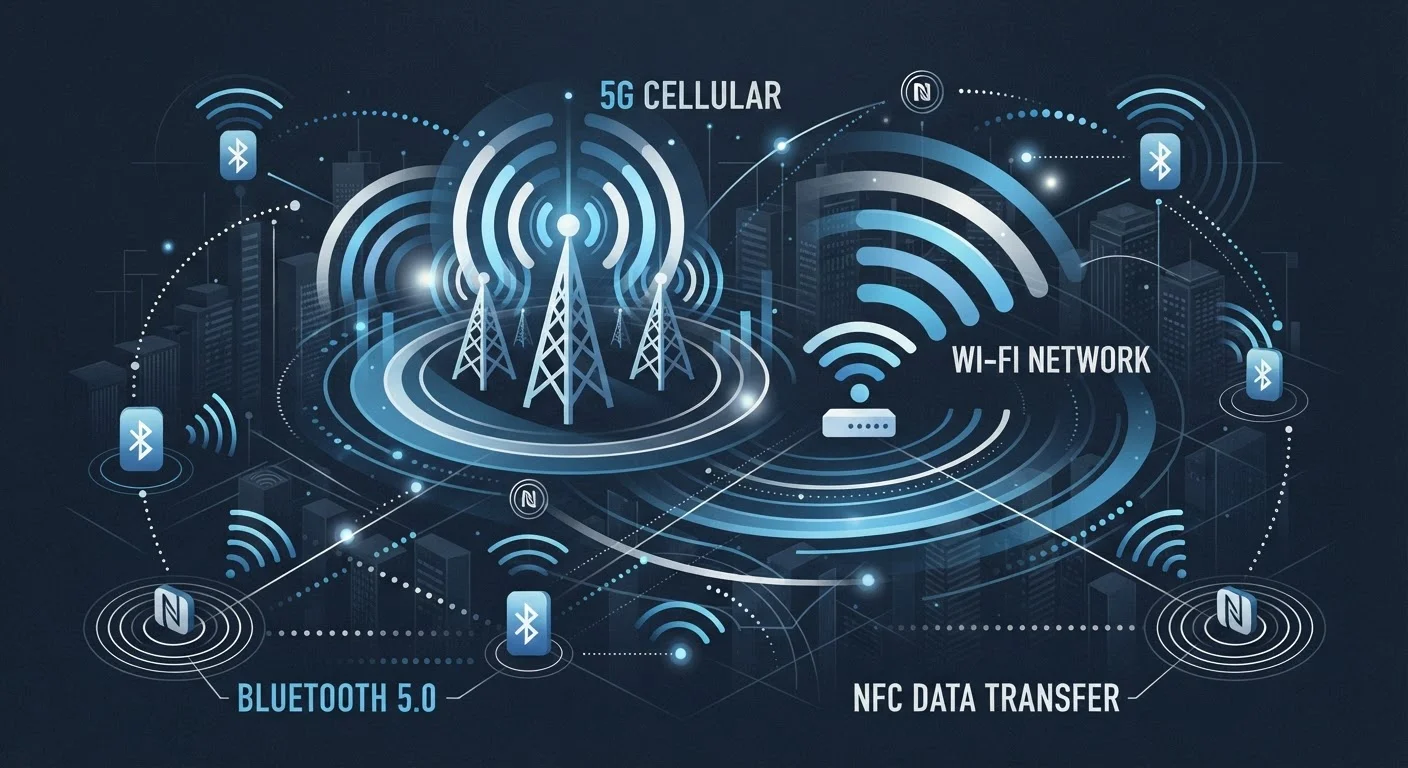
Photo credit: TheBlogZappier.com | Simple Search, Credible Results
In this article
A quick-reference breakdown of every wireless standard you'll find listed on a smartphone or tablet spec sheet.
Why These Four Standards Show Up on Every Spec Sheet
When you read a smartphone or tablet listing, you'll almost always see a cluster of wireless labels: 5G, Wi-Fi 6, Bluetooth 5.x, NFC. They're not interchangeable — each one solves a different connectivity problem at a different range and speed. Understanding what each standard actually does helps you decide which ones matter for how you use a device, rather than treating them as a checklist of marketing terms.
For a broader look at how specs translate to real-world performance, see our guide to phone specs.
5G
The fifth generation of cellular network technology, used for mobile data when away from a Wi-Fi network. Performance depends heavily on the frequency band and carrier coverage in a given area.
Latency
The time delay between sending a data request and receiving a response, measured in milliseconds. Lower latency means a more responsive connection, which matters for real-time applications like gaming or video calls.
Wi-Fi 6 (802.11ax)
A wireless networking standard designed for higher efficiency in environments with many connected devices. It offers improved throughput and better performance on crowded networks compared to Wi-Fi 5.
Wi-Fi 6E
An extension of Wi-Fi 6 that adds support for the 6 GHz frequency band. This band is less congested than 2.4 GHz or 5 GHz, but both the device and the router must support it to benefit.
Bluetooth
A short-range wireless standard used to connect personal devices such as headphones, keyboards, and speakers within roughly 30 feet. Higher version numbers generally reflect improvements to range, speed, and power efficiency.
NFC
Near Field Communication — a very short-range wireless technology used for tap-to-pay transactions, transit card emulation, and quick device pairing. It works only at close range, typically a few centimeters.
mmWave (Millimeter-Wave)
A high-frequency band used in some 5G deployments that delivers very fast speeds over short distances. It has limited range and does not penetrate walls well, so availability is concentrated in dense urban areas.
Sub-6 GHz 5G
A lower-frequency 5G band that covers wider areas than mmWave but with more moderate speed gains over 4G LTE. Most carriers rely on sub-6 GHz 5G for broad network coverage.
5G: Cellular Data, Not a Wi-Fi Upgrade
5G is the fifth generation of cellular network technology. It replaces 4G LTE as the standard for mobile data when you're away from a Wi-Fi network — think streaming video on a commute or using maps in an area with no home network. The headline promise is faster speeds and lower latency (the delay between sending a request and receiving a response).
In practice, 5G performance varies considerably depending on the frequency band your carrier deploys. Sub-6 GHz 5G covers wide areas with speeds modestly faster than good 4G LTE. Millimeter-wave (mmWave) 5G is much faster but has limited range and struggles to penetrate walls, so it's mainly found in dense urban environments. Whether 5G makes a meaningful difference for you depends on your carrier's network in the areas you actually use your phone.
| 5G primary use | Mobile data away from Wi-Fi |
| 5G sub-6 GHz coverage | Wide area, moderate speed gain over 4G LTE |
| 5G mmWave coverage | Short range, very high speed, mainly dense urban areas |
| Wi-Fi 6 standard name | IEEE 802.11ax |
| Wi-Fi 6E added band | 6 GHz (requires compatible router) |
| Bluetooth typical range | Up to ~30 feet (varies by version and environment) |
| NFC operating range | A few centimeters |
| NFC common uses | Tap-to-pay, transit cards, quick device pairing |
Wi-Fi 6 and Wi-Fi 6E: Home and Office Wireless
Wi-Fi 6 (formally IEEE 802.11ax) is a home and office wireless standard — it's what connects your phone to your router, not to a cell tower. Compared to its predecessor Wi-Fi 5 (802.11ac), Wi-Fi 6 is more efficient in congested environments, meaning it handles more simultaneous devices without slowing down as much. Raw throughput is also higher under ideal conditions.
Wi-Fi 6E extends those improvements into the 6 GHz frequency band, which is less crowded than the 2.4 GHz and 5 GHz bands used by older standards. A Wi-Fi 6E device can tap into that less congested airspace — but only if your router also supports Wi-Fi 6E. Having the standard on a device spec sheet matters less if your home network equipment doesn't match. Before connecting any new device, it's worth reviewing key setup checks for smart devices.
Bluetooth and NFC: Short-Range Connections
Bluetooth is designed for short-range connections — typically within about 30 feet — between personal devices. The most common uses are wireless headphones, speakers, keyboards, mice, and car audio systems. The version number on a spec sheet (e.g., Bluetooth 5.3) generally reflects improvements to range, speed, and connection stability, as well as energy efficiency for accessories like fitness trackers. Higher version numbers indicate a newer implementation of the standard.
NFC (Near Field Communication) operates at an extremely short range — usually a few centimeters. It's the technology behind tap-to-pay mobile payments, transit card emulation, and quick device pairing with compatible accessories. NFC doesn't transmit large amounts of data; it's optimized for fast, secure handshakes between nearby devices.
~30 ft
Typical Bluetooth effective range
Bluetooth range varies by version and environment; walls and interference can reduce it significantly in real-world use.
< 4 cm
NFC operating distance
NFC is intentionally limited to close range to reduce the risk of unintended data exchanges and support secure payment interactions.
3
Frequency bands Wi-Fi 6E supports
Wi-Fi 6E operates across 2.4 GHz, 5 GHz, and 6 GHz — the 6 GHz addition is what differentiates it from standard Wi-Fi 6.
If you're switching phones and want to make sure your accessories and payment methods carry over, this pre-switch checklist covers compatibility questions worth addressing ahead of time.
How to Read These Specs When Shopping
None of these standards guarantee a particular real-world experience on their own. 5G on a device only matters if your carrier has 5G coverage where you live and work. Wi-Fi 6 only delivers its advantages when paired with a compatible router. Bluetooth version numbers matter more for battery-powered accessories than for everyday audio. NFC is essentially binary — a device either has it or it doesn't.
If you're new to evaluating phones more broadly, a first-time buyer's overview of smartphone specs is a useful starting point. And for understanding SIM-related connectivity — including how eSIM works alongside these wireless standards — see how SIM, eSIM, and dual-SIM setups differ.
Spec Sheet Labels vs. Real-World Experience
A device listing a wireless standard doesn't guarantee you'll experience its full benefits. 5G requires carrier coverage, Wi-Fi 6 requires a compatible router, and Bluetooth improvements depend on whether your accessories support the same version. Always consider the full ecosystem — device, network, and accessories — not just the label on the spec sheet.

Author
Tech & Electronics Editorial Team
Tech & Electronics Editorial Team is the collective byline for our editorial team and contributor network. Articles published under this byline or an editorial pen name are researched, written, and reviewed according to our editorial standards for clarity, consistency, and independence before publication.
View all articles →