
Wired vs. Wireless Audio: The Real Tradeoffs for Home Listening
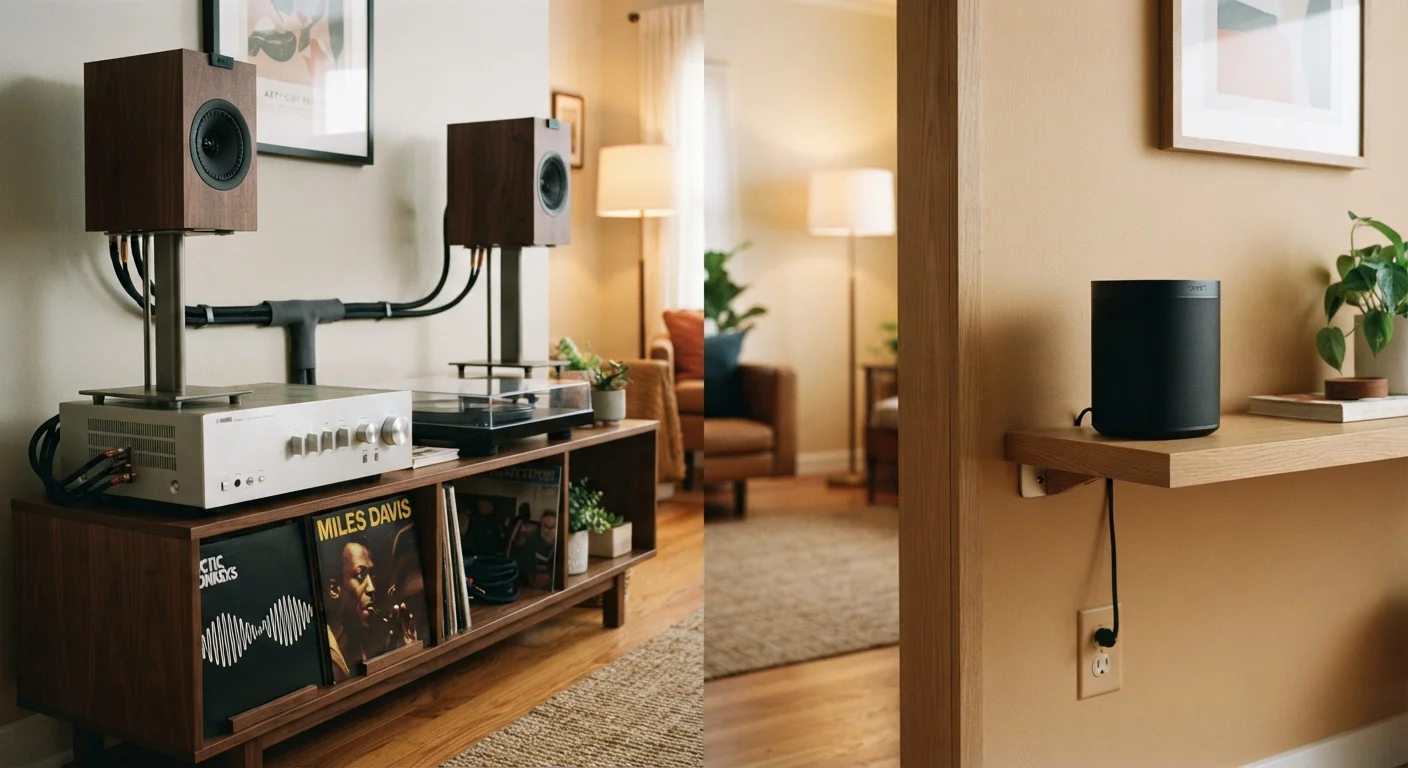
Photo credit: TheBlogZappier.com | Simple Search, Credible Results
In this article
Explore the practical differences between wired and wireless home audio setups, from latency and fidelity to convenience.
Key Takeaways
- Wired connections pass audio signals without compression or conversion, keeping the signal path simple.
- Wireless audio introduces latency and relies on codecs that may compress audio data in transit.
- Modern wireless codecs like aptX HD and LDAC have narrowed — but not eliminated — quality gaps with wired setups.
- Wireless systems can suffer from interference, dropout, and battery degradation over time.
- Room acoustics often have a larger impact on perceived sound quality than the connection type itself.
- Your listening habits and room layout should drive the wired vs. wireless decision more than spec sheets.
How Each Connection Actually Works
Wired audio sends an electrical signal directly from a source — an amplifier, receiver, or DAC (digital-to-analog converter) — through a cable to a speaker or headphone. The signal path is straightforward: no encoding, no transmission, no decoding on the other end. That simplicity is the core of wired audio's reliability.
Wireless audio works differently. A transmitter encodes the audio signal, sends it over Bluetooth or Wi-Fi radio frequencies, and a receiver on the other end decodes it before it reaches the speaker driver. Every step in that chain introduces the possibility of delay, dropout, or data loss — how much depends heavily on the wireless protocol and codec being used.
Bluetooth audio relies on codecs — compression formats — to move audio efficiently over radio. The most common is SBC, which is universal but applies noticeable compression. Higher-tier codecs like aptX, aptX HD, AAC, and Sony's LDAC transmit more audio data and with less compression, narrowing the gap with wired fidelity. Wi-Fi-based systems (used in multi-room audio platforms) can transmit lossless audio, which puts them much closer to wired quality — though they still introduce some latency. See our guide to bitrate and codecs for a deeper look at what these formats actually change.
| Criterion | Wired Audio | Wireless Audio |
|---|---|---|
| Signal path | Direct electrical connection | Encoded, transmitted, decoded |
| Latency | Under 1ms (imperceptible) | 40–250ms depending on codec |
| Audio compression | None | Varies by codec (SBC to LDAC) |
| Interference risk | None | Moderate (RF crowding, obstacles) |
| Battery required | No | Yes (degrades over time) |
| Cable management | Required | None |
| Speaker placement flexibility | Limited by cable length | High |
| Multi-room audio | Complex wiring needed | Easy with Wi-Fi platforms |
Latency, Interference, and Real-World Reliability
Latency — the delay between a signal leaving the source and arriving at your ears — is measurable in both wired and wireless systems, but the gap is significant. Wired systems operate with latency so low it's imperceptible, typically under a millisecond. Bluetooth audio latency ranges widely: standard SBC can run 150–250ms, while aptX Low Latency targets under 40ms. For pure music listening, even 200ms of latency may be unnoticeable. But for video or gaming, audio that lags behind picture is disruptive.
Wireless systems are also susceptible to radio frequency interference. Dense Wi-Fi environments, microwave ovens, and neighboring Bluetooth devices all operate in the 2.4GHz band. Dropouts, stutters, and signal degradation are genuine risks — less so in a quiet home network, more so in a dense apartment building. Wired connections don't have this vulnerability.
150–250ms
Typical Bluetooth SBC latency range
Standard SBC codec latency, compared to aptX Low Latency's target of under 40ms, according to published codec specifications.
990 kbps
Maximum LDAC transmission rate
Sony's LDAC codec can transmit up to 990 kbps, compared to SBC's typical ceiling of around 345 kbps, per Sony's published specifications.
2.4 GHz
Shared band for Bluetooth and Wi-Fi
Most Bluetooth audio and standard Wi-Fi networks share the 2.4GHz radio band, which can cause interference in high-density environments.
Battery dependency is another practical factor. Wireless speakers and headphones require charging, and battery capacity degrades over time. A wired system has none of these constraints — plug it in and it works. For a fixed home listening setup, that reliability difference is worth factoring in.
Sound Quality: What the Specs Don't Tell You
It's tempting to assume wired is always better-sounding than wireless, but the reality is more nuanced. For the majority of listeners in typical home environments, the quality difference between a good wireless system using a capable codec and a wired equivalent is smaller than the difference introduced by room acoustics, speaker placement, or the quality of the recording itself.
Common audio myths often inflate the importance of the connection type while underplaying environmental factors. A wireless speaker placed in a reflective, bare-walled room will almost always sound worse than a wired speaker in a well-treated space — even if the wired signal is theoretically purer. Your room is part of your audio system, and room acoustics shape more of what you hear than most people realize.
Where the quality gap between wired and wireless becomes more audible: high-resolution audio files played through a revealing system with careful listening. In that context, the absence of any compression or encoding step in a wired setup is a genuine advantage. For casual streaming of standard-resolution content — which most people do most of the time — the gap is largely academic.
It's also worth understanding how the speaker itself is designed. Active vs. passive speaker design affects how a wired signal is amplified and handled, which can matter as much as the cable itself.
Wi-Fi Audio vs. Bluetooth Audio
Not all wireless audio is Bluetooth. Wi-Fi-based audio platforms — used in many multi-room systems — can stream lossless audio at full CD quality or higher, since they're not bound by Bluetooth's bandwidth limits. If audio fidelity matters but you still want wireless flexibility, Wi-Fi-based systems are worth considering separately from Bluetooth. The tradeoff is that they require a stable home network and are generally less portable than Bluetooth devices.

Author
Tech & Electronics Editorial Team
Tech & Electronics Editorial Team is the collective byline for our editorial team and contributor network. Articles published under this byline or an editorial pen name are researched, written, and reviewed according to our editorial standards for clarity, consistency, and independence before publication.
View all articles →