
Passive vs. Active Speakers: Understanding the Amplifier Inside (or Outside) Your Audio Gear
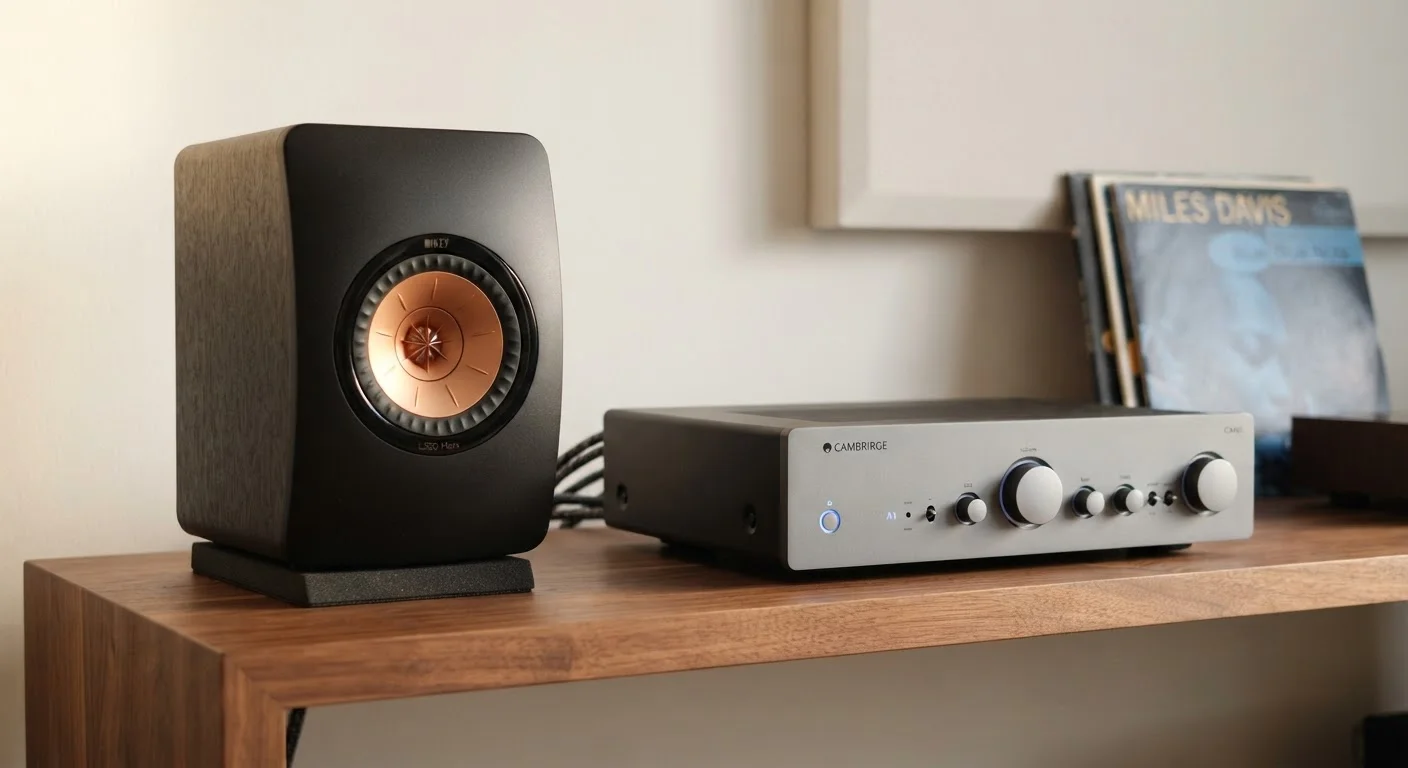
Photo credit: TheBlogZappier.com | Simple Search, Credible Results
In this article
What distinguishes a passive speaker from an active one, and how that difference shapes system setup, cost, and flexibility.
Key Takeaways
- Passive speakers require a separate amplifier or receiver to produce sound; active speakers have amplification built in.
- Active speakers reduce setup complexity but limit your ability to swap or upgrade individual components.
- Passive systems offer more flexibility for long-term upgrades but require matching components carefully.
- Neither type is universally better — the right choice depends on your listening goals and how much gear you want to manage.
- Cost comparisons are not straightforward: you must factor in the amplifier when pricing a passive setup.
What the Terms Actually Mean
The difference between passive and active speakers comes down to one question: where does the amplifier live?
A passive speaker contains only the drivers (the components that move air and produce sound) and a crossover network that divides the audio signal between those drivers by frequency. It has no power source of its own. To work, it must be connected to a separate external amplifier or AV receiver, which boosts the audio signal to a level the speaker can use.
An active speaker — sometimes called a powered speaker — has one or more amplifier circuits built directly into the cabinet. You plug it into a power outlet, connect your audio source, and it handles amplification internally. Some active speakers also include digital-to-analog converters (DACs) and onboard equalization, making them even more self-contained.
This distinction affects everything downstream: how you set the system up, what else you need to buy, and how the system behaves over time. For a broader look at how connection type also shapes your audio experience, see wired vs. wireless audio tradeoffs.
| Criterion | Passive Speakers | Active Speakers |
|---|---|---|
| Built-in amplifier | No — requires external amp | Yes — included in cabinet |
| Setup complexity | Higher — matching required | Lower — plug in and connect source |
| Component upgradeability | High — amp and speakers separate | Low — amp and speakers bundled |
| Total system cost transparency | Price excludes amplifier | Price includes amplification |
| Typical use cases | Home theater, hi-fi stereo | Desktop, studio monitoring, simple stereo |
| Power source required | Via external amplifier only | Direct wall outlet connection |
Setup, Cost, and Flexibility
Active speakers are generally easier to set up. Because amplification is built in and matched to the drivers at the factory, there's less guesswork. You connect a source — a turntable, a streaming device, a computer — and the system works. That simplicity is genuinely useful, especially in smaller spaces or desktop environments.
Passive speakers carry more initial complexity. You need to select an amplifier or receiver that's compatible with your speakers' impedance (measured in ohms) and power requirements, and you need speaker wire to connect them. Done thoughtfully, this pairing can yield excellent results. Done carelessly, a mismatch can produce poor sound or, in extreme cases, damage components.
On cost, be careful with direct comparisons. A passive speaker's sticker price doesn't include the amplifier — which is a real and sometimes substantial additional expense. An active speaker's price includes that amplification. When comparing the two approaches, total system cost is the fair metric.
2–4 components
Typical passive system component count
A basic passive setup generally includes at minimum a source, a separate amplifier or receiver, and the speakers themselves — each a discrete purchase.
1 unit
Active speaker system component count
Active speakers consolidate source input, amplification, and drivers into a single cabinet, reducing the number of separate devices needed.
Where passive systems earn back their complexity is in long-term flexibility. If a better amplifier becomes available, or your listening tastes change, you can upgrade one component without replacing the whole system. With an active speaker, the amplifier and drivers are a package — if you want a better amplifier, you generally need new speakers. This is worth considering if you anticipate wanting to evolve your setup. And before finalizing any speaker decision, speaker placement will matter just as much as which type you choose.
Sound Quality: Does the Type Determine the Outcome?
Neither passive nor active speakers hold an inherent sound quality advantage. Quality is determined by the engineering of the individual product — the drivers, cabinet construction, amplifier design, and crossover implementation — not by whether the amplifier is inside or outside the box.
One argument sometimes made for active designs is that the manufacturer controls the entire signal chain. The amplifier is tuned specifically for those drivers, which can allow for tighter optimization. Some active speakers include built-in digital signal processing (DSP) that corrects for the speaker's own frequency response or even adapts to room acoustics.
Passive systems, by contrast, allow audiophiles to choose amplification that matches their preferences — a tube amplifier for a warmer character, a high-current solid-state amp for demanding speakers, and so on. Whether that granular control produces meaningfully better results depends on how carefully choices are made — and it's worth setting aside some common assumptions. Common audio myths around watts and component hierarchy are worth examining before committing to either path.
Powered vs. Active: A Common Terminology Overlap
The terms 'powered' and 'active' are often used interchangeably in consumer marketing, but technically they can mean different things. A powered speaker has a built-in amplifier but may still use a passive crossover. A true active speaker has separate amplifier channels for each driver, with the crossover occurring before amplification. In practice, consumer products rarely make this distinction clearly, so it's worth checking a product's specifications if the internal design matters to your purchasing decision.
Your room will shape the sound of either system significantly. Before adjusting speaker settings or blaming gear, consider reading about how room acoustics affect what you hear. And if you're still deciding between speaker configurations overall, matching audio formats to your room offers useful perspective.

Author
Tech & Electronics Editorial Team
Tech & Electronics Editorial Team is the collective byline for our editorial team and contributor network. Articles published under this byline or an editorial pen name are researched, written, and reviewed according to our editorial standards for clarity, consistency, and independence before publication.
View all articles →