
What Pet Food Labels Actually Tell You — and What They Don't
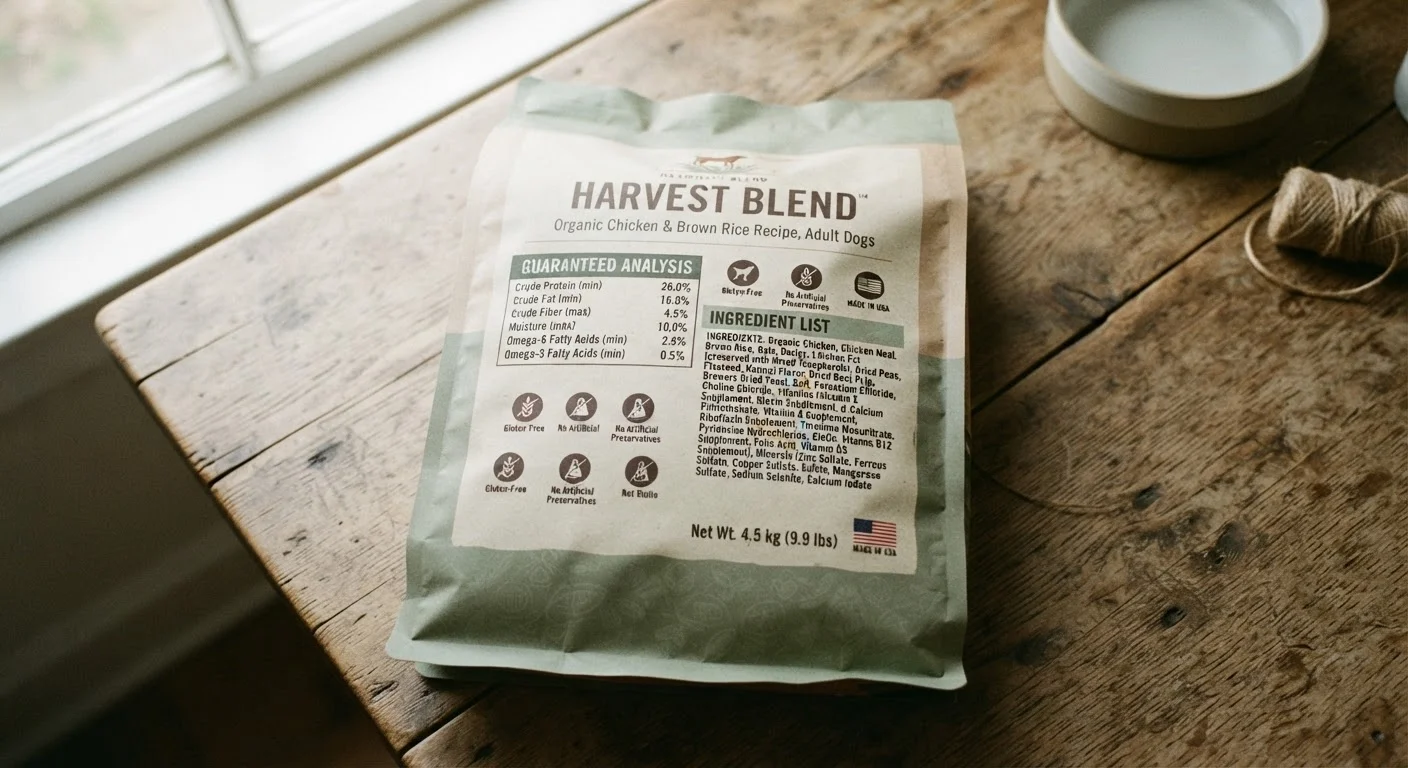
Photo credit: TheBlogZappier.com | Simple Search, Credible Results
In this article
Decode guaranteed analysis, ingredient lists, and AAFCO statements so you know what's really in your pet's food.
Key Takeaways
- Ingredient lists are ordered by pre-cooking weight, not nutritional contribution after processing.
- The guaranteed analysis shows minimum or maximum percentages, not exact nutrient amounts.
- An AAFCO nutritional adequacy statement tells you whether a food is formulated for a specific life stage.
- Marketing claims like 'natural' or 'premium' have no standardized legal definition in pet food.
- Calorie content is required on labels and is a practical tool for managing portion sizes.
- Labels cannot tell you ingredient sourcing, processing temperature, or actual digestibility.
The Six Required Sections on Every Label
Federal and state regulations require every pet food sold in the U.S. to carry six core pieces of information: the product name, the net quantity, the manufacturer's name and address, the ingredient list, the guaranteed analysis, and a nutritional adequacy statement. Understanding what each section is legally required to show — and what it is not required to show — is the foundation of reading any label confidently.
The product name itself carries rules. If a protein source appears in the name without qualifiers, AAFCO's ingredient naming rules require it to make up a high proportion of the product. Words like 'with' or 'flavor' dramatically lower that threshold. A food called 'Salmon Entrée' contains a different minimum salmon percentage than one called 'With Salmon' or simply 'Salmon Flavor.'
For a broader look at how label-reading skills transfer across product categories, compare our approach here with the walkthrough of human food nutrition labels, which uses similar panel logic.
Check the Life Stage Before Anything Else
Before analyzing ingredients or percentages, find the nutritional adequacy statement and confirm the food is formulated for your pet's current life stage — puppy/kitten, adult, or senior. A food 'for supplemental feeding only' or lacking an AAFCO statement is not a complete diet and should not be served as the sole daily meal.
Decoding the Ingredient List
Ingredients are listed in descending order by pre-processing weight, which matters because moisture content inflates the apparent ranking of fresh meats. A whole chicken listed first may contribute less actual protein than a 'chicken meal' listed third, because meal is a concentrated, moisture-removed ingredient. This does not make either ingredient better or worse — it simply means position alone is an incomplete guide.
Ingredient splitting is another pattern worth recognizing. A manufacturer may list 'ground corn,' 'corn gluten meal,' and 'corn bran' separately, which keeps each lower on the list than a single combined 'corn' entry would appear. This is legal and not inherently deceptive, but it does affect how you interpret the ranking.
For definitions of specific terms you encounter — such as taurine, omega fatty acids, or 'by-product meal' — our pet food nutrient glossary offers quick-reference explanations grounded in current nutritional science.
Ingredient Order Reflects Raw Weight, Not Nutrition
The pre-cooking weight rule means water-heavy ingredients like fresh chicken or beef rank higher than their post-processing nutritional contribution might suggest. 'Chicken meal,' lower on the list, is a concentrated protein source with moisture already removed. Neither placement automatically signals a superior or inferior product — context and the full ingredient panel matter more than position alone.
The Guaranteed Analysis: What the Numbers Actually Mean
The guaranteed analysis panel lists minimum percentages for crude protein and crude fat, and maximum percentages for crude fiber and moisture. These are guaranteed limits, not exact values — the actual content in the bag may be higher (for minimums) or lower (for maximums). This makes direct brand-to-brand comparisons tricky, especially across wet and dry foods with very different moisture levels.
To compare a wet food to a dry food meaningfully, nutritionists use a dry matter basis calculation: subtract the moisture percentage from 100, then divide the nutrient percentage by that number and multiply by 100. This converts both foods to the same reference point. For example, a wet food showing 8% crude protein at 78% moisture calculates to about 36% protein on a dry matter basis — comparable to many dry kibbles.
6
Required label elements per U.S. regulations
AAFCO model regulations, adopted by most U.S. states, specify six mandatory label components for commercially sold pet food.
~78%
Typical moisture content in canned wet pet food
This high moisture level is why wet food nutrient percentages appear lower on labels and require dry matter conversion for accurate comparisons.
3
Minimum thresholds under AAFCO naming rules
AAFCO's ingredient-naming rules set three distinct thresholds (roughly 95%, 25%, and 3%) tied to terms like 'dinner,' 'with,' and 'flavor' in product names.
Labels do not list digestibility, amino acid profiles, or vitamin retention after processing. For pets with suspected food sensitivities or allergies, the guaranteed analysis is a starting point, not a diagnosis tool — work with a veterinarian for individualized guidance.
The AAFCO Statement and What It Guarantees
The nutritional adequacy statement — often called the AAFCO statement — is arguably the most important single line on the label. It tells you whether the food is formulated to meet AAFCO nutrient profiles for a life stage (growth, adult maintenance, reproduction, or all life stages) or whether it was validated through an actual feeding trial.
Formulated foods are tested against a nutrient profile in a lab. Feeding trial foods were fed to real animals under controlled conditions and monitored for health outcomes. Both approaches are acceptable under current standards, but they answer slightly different questions about real-world performance.
Some labels carry the phrase 'for intermittent or supplemental use only,' which means the food does not meet complete and balanced standards and should not be a pet's sole diet. Our dedicated article on reading the AAFCO statement walks through each phrase and what it means in practice.
Marketing Claims: What the Label Cannot Promise
Terms like 'holistic,' 'premium,' 'human-grade,' and 'superfood' have no standardized regulatory definition in U.S. pet food law. They are marketing language, and their presence on a label does not guarantee a nutritional standard above the regulated minimums. Even 'natural' — which AAFCO does define loosely — permits exceptions for synthetic vitamins and minerals that are added to virtually every commercial pet food.
'Grain-free' is a good example of a claim that requires context. The absence of grains does not automatically make a food higher in protein or lower in carbohydrates — many grain-free formulas substitute legumes or potatoes. Our article on grain-free pet diets and the evidence examines what research currently suggests about these formulas.
What labels also cannot tell you: where ingredients were sourced, what processing temperature was used, how digestible the protein actually is for your specific pet, or how a food performs over a lifetime. These are legitimate questions that go beyond what current labeling requirements can answer. For complete feeding guidance tailored to your pet, a veterinary nutritionist remains the most reliable resource.
This article is for general informational purposes only and is not a substitute for veterinary nutritional advice. Consult a licensed veterinarian for guidance specific to your pet's health and dietary needs.
Frequently Asked Questions

Author
Pets & Animals Editorial Team
Pets & Animals Editorial Team is the collective byline for our editorial team and contributor network. Articles published under this byline or an editorial pen name are researched, written, and reviewed according to our editorial standards for clarity, consistency, and independence before publication.
View all articles →