
Style & Beauty Trends Through the Decades: A Complete Reference to Seasonal Cycles
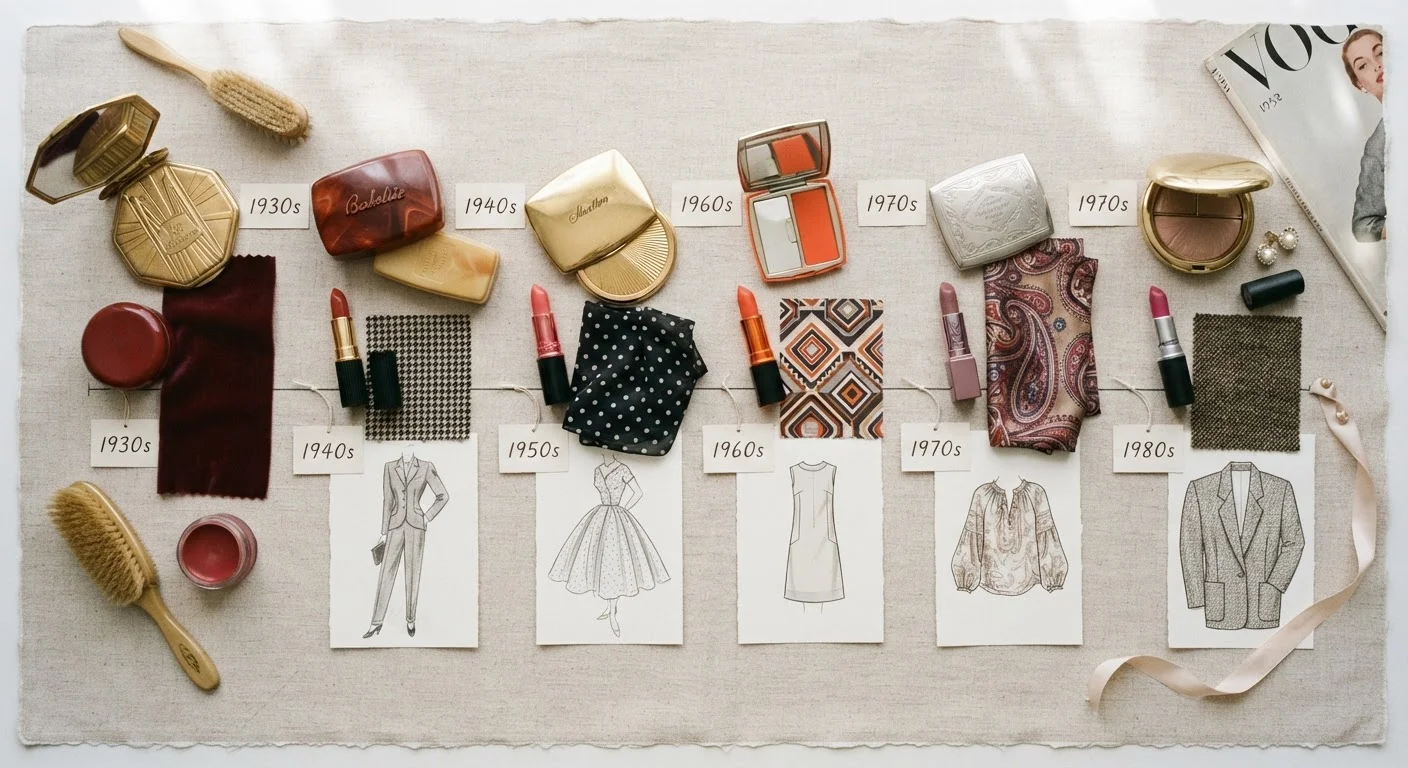
Photo credit: TheBlogZappier.com | Simple Search, Credible Results
In this article
An end-to-end look at how seasonal trends in fashion and beauty have evolved, recurred, and been reinterpreted over time.
Key Takeaways
- The traditional fashion calendar — Spring/Summer and Fall/Winter — emerged from European couture houses in the early 20th century.
- Beauty trends generally follow fashion's seasonal logic but respond more directly to cultural mood and technological breakthroughs.
- Most trends operate in cycles; elements dismissed as dated reliably resurface, reinterpreted for contemporary contexts.
- Understanding micro-trends versus macro-trends helps consumers decide what's worth adopting versus what will quickly feel dated.
- Personal style acts as a filter, letting you draw on trend knowledge without being governed by it.
How Seasonal Cycles Became the Backbone of Fashion
The concept of a structured fashion season is largely a 20th-century invention, rooted in the rhythms of European couture. By the mid-1900s, Paris houses were presenting Spring/Summer (SS) and Fall/Winter (FW) collections on a fixed calendar, establishing a framework that retailers worldwide eventually adopted. That biannual structure shaped not only what reached stores but also when consumers expected novelty.
Over time, the calendar expanded. Pre-fall, resort (cruise), and high-summer deliveries were added to keep retail floors refreshed between main seasons. Today, the fashion calendar is more layered than ever, with drops occurring almost continuously — a direct response to digital commerce and shifting consumer expectations.
Seasonality in beauty followed a parallel, if less formalized, path. Color cosmetics collections tied to holidays and season-change moments became a retail standard by the latter half of the 20th century. The logic was clear: lighter textures and brighter palettes in spring and summer; deeper, richer formulas in fall and winter.
Navigating the Expanded Fashion Calendar
With pre-fall, resort, and main season collections all reaching stores at different times, it helps to think in terms of 'delivery windows' rather than strict seasons. Retail arrivals in August often reflect pre-fall themes, while the main Fall/Winter collection typically hits floors in September and October. Knowing these windows prevents seasonal confusion when browsing new arrivals.
Decade-by-Decade: Key Trend Movements and Their Seasonal Logic
Each decade introduced aesthetic signatures that operated within — and sometimes deliberately against — the seasonal framework.
- 1950s–1960s: Post-war optimism drove a structured, silhouette-focused approach. Seasonal collections were genuine events; what appeared on a Parisian runway in February genuinely set the tone for what mainstream consumers wore six months later. The runway show was information, not spectacle.
- 1970s: Decentralization began. Ready-to-wear challenged couture's authority, and seasonal rules relaxed. Earth tones and natural fabrics transcended strict season assignments, reflecting a cultural shift toward practicality.
- 1980s–1990s: Power dressing, minimalism, and grunge each demonstrated how macro-level cultural moments could override seasonal color and silhouette conventions. Spring palettes became bolder; autumn collections grew more conceptual.
- 2000s–2010s: Fast fashion compressed the cycle dramatically. Trend-to-shelf timelines shrank from months to weeks, and seasonal boundaries blurred as global supply chains made lightweight summer fabrics available year-round.
- 2020s: The pandemic disrupted the calendar further — many houses skipped seasons or merged collections — while resale culture and a renewed interest in archive fashion introduced non-linear trend consumption.
~20–30 yrs
Typical macro-trend revival cycle
Fashion historians and industry analysts generally estimate that major aesthetic movements resurface in a modified form within one to two generations.
4–6 weeks
Fast fashion trend-to-shelf timeline
Industry reporting in the 2010s documented that some fast fashion retailers compressed runway-to-retail cycles to as little as four to six weeks, compared to six months historically.
Beauty Trends and the Seasonal Cycle
Beauty's relationship with seasonality is simultaneously more intuitive and more responsive than fashion's. Skin needs genuinely shift with temperature and humidity, which grounds seasonal product cycles in practical logic beyond pure aesthetics. Richer moisturizers, deeper lip colors, and warming bronzer formulas in autumn and winter are not arbitrary — they reflect real environmental conditions.
At the cultural level, beauty trends track decade shifts closely. The sculpted brows and bold lip of the 1950s gave way to the graphic liner of the 1960s; the barely-there 1990s skin eventually shifted toward the fuller-coverage, contoured looks that dominated the 2010s. Each movement reflected broader values — natural, dramatic, minimal, maximalist — cycling back in modified form roughly every two to three decades.
The beauty essentials landscape has also been shaped by ingredient innovation. Retinoids, AHAs, and SPF-focused formulations created new categories of seasonal skincare that didn't exist before the late 20th century, adding a functional dimension to seasonal beauty cycles that purely trend-driven analysis misses.
When evaluating whether a revival trend is worth investing in, look at how many distinct retail categories it spans — if it's showing up in footwear, outerwear, and accessories simultaneously, that signals macro movement, not a fleeting moment.
Macro-trends tend to appear across multiple product categories at once, whereas micro-trends typically concentrate in a single item type before fading.
For seasonal beauty transitions, focus first on texture before switching formulas entirely — swapping a lightweight moisturizer for a richer version is usually more effective than overhauling your entire routine with each season change.
Skin's barrier function responds to humidity and temperature shifts; adjusting emollient weight addresses the most common seasonal skin concerns without disrupting a routine that's already working.
How Trends Recur: The Mechanics of Revival
Trend cycles are not random. They follow recognizable patterns driven by generational memory, the commercial incentive to introduce novelty, and nostalgia's reliable power. A style that was omnipresent in one decade typically re-emerges in softer, updated form roughly 20–30 years later — when the generation that grew up around it reaches cultural and purchasing influence.
Understanding the difference between a micro-trend and a macro-trend is essential for reading revivals accurately. A macro-trend — wide-leg trousers returning to dominance, for example — represents a genuine directional shift supported across multiple markets. A micro-trend — a very specific silhouette or colorway going viral — may peak and vanish within a single season.
Social media has accelerated micro-trend cycling considerably, creating the impression that the entire trend landscape moves faster. In practice, macro-trends still operate on longer timescales; the acceleration is concentrated at the micro level.
“Fashion is not something that exists in dresses only. Fashion is in the sky, in the street; fashion has to do with ideas, the way we live, what is happening.”
— Coco Chanel, Pioneer of modern fashion design and founder of the Chanel house
Using Trend Awareness Without Losing Personal Style
The purpose of understanding trend cycles is not to follow them slavishly — it is to make more informed choices. Following trends too closely creates wardrobes that date quickly and feel inconsistent. Trend literacy, by contrast, helps you identify which movements align with your existing aesthetic and which are better observed than adopted.
A practical approach: treat macro-trends as long-term context and micro-trends as optional accents. A broad silhouette shift is worth noting because it may affect how foundational pieces like trousers or outerwear fit into a wardrobe over time. A specific embellishment trend, by contrast, may be incorporated through a lower-commitment item — a single accessory rather than a full outfit overhaul.
For consumers building or refining their aesthetic, building a personal style from scratch provides a more durable foundation than chasing seasonal shifts. Trend awareness becomes genuinely useful once you have clarity on your preferences — it helps you contextualize, not define, your choices. The seasonal cycle is a framework, not a mandate.
This article is for informational and educational purposes only. It represents the editorial perspective of the Style & Beauty Editorial Team and does not constitute professional fashion, financial, or personal styling advice.

Author
Style & Beauty Editorial Team
Style & Beauty Editorial Team is the collective byline for our editorial team and contributor network. Articles published under this byline or an editorial pen name are researched, written, and reviewed according to our editorial standards for clarity, consistency, and independence before publication.
View all articles →