
Pet Nutrition Labels Decoded: What Those Ingredients Actually Mean
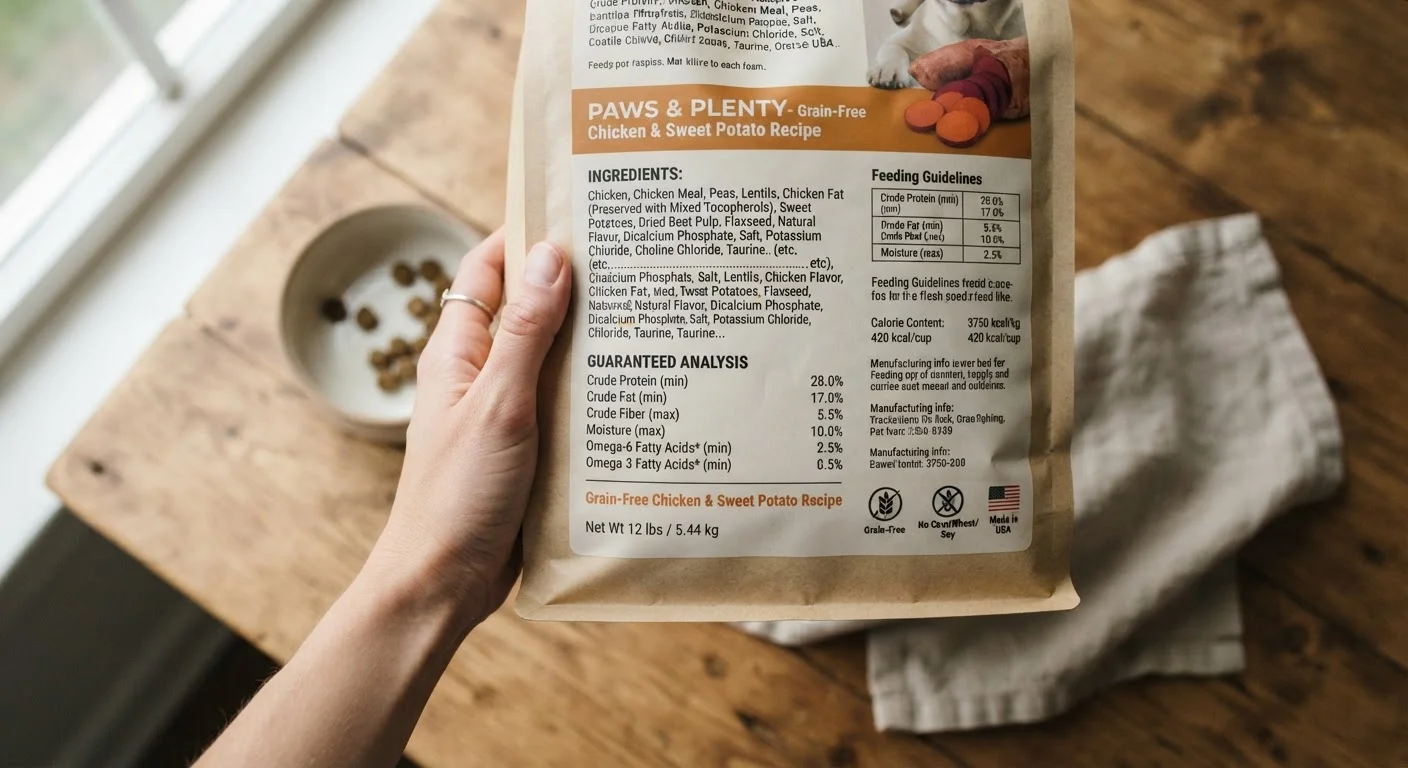
Photo credit: TheBlogZappier.com | Simple Search, Credible Results
In this article
Ingredient lists on pet food can be confusing. Learn what key terms, guaranteed analyses, and AAFCO statements really tell you about your pet's diet.
Key Takeaways
- Ingredients are listed by pre-cooking weight, so moisture content can make some ingredients appear more prominent than they really are.
- The guaranteed analysis shows minimum or maximum nutrient levels, not exact amounts — it is a floor, not a precise measure.
- An AAFCO nutritional adequacy statement tells you whether a food is 'complete and balanced' and for which life stage.
- Marketing terms like 'premium' or 'natural' have limited regulatory definitions and should not be the primary basis for food selection.
- Your veterinarian is the best resource for matching a specific food to your individual pet's health needs.
How the Ingredient List Actually Works
Flip to the back of any commercial pet food bag and the ingredient list can look overwhelming — a dense column of chemical-sounding names and unfamiliar terms. But this list follows a clear structure once you understand the rules behind it.
Every ingredient is listed in descending order by weight before cooking or processing. This is an important detail. Fresh meats — chicken, beef, salmon — contain 60–75% water. That water weight pushes them toward the top of the list, even if the dried, concentrated form of a grain or meal ingredient makes up more of the final product by dry weight. A food listing 'deboned chicken' first is not necessarily higher in animal protein than one listing 'chicken meal,' because chicken meal is already moisture-removed and is therefore more protein-dense per pound.
Ingredients like 'chicken meal,' 'salmon meal,' or 'turkey meal' represent rendered, dehydrated protein concentrates. They are not inferior to fresh meat — they simply reflect a different processing stage. For a deeper look at how ingredient sourcing differs across product categories, see our guide on how commercial pet foods compare across diet categories.
Watch for Ingredient Splitting
Some manufacturers list similar ingredients separately to push them lower on the list — for example, 'ground corn,' 'corn gluten meal,' and 'corn bran' might each appear independently. If you add them together, corn could outweigh the first-listed protein ingredient. Scanning the full list, not just the top few entries, gives you a more accurate picture of the diet's overall composition.
Decoding the Guaranteed Analysis Panel
Beneath or beside the ingredient list you'll find the guaranteed analysis — a small table listing percentages for crude protein, crude fat, crude fiber, and moisture. These numbers are frequently misread.
The values shown are minimums for protein and fat, and maximums for fiber and moisture. This means a food guaranteed at 26% crude protein must contain at least that amount, but could contain more. Similarly, a maximum of 5% crude fiber means the product won't exceed that level — it could be lower.
Crucially, 'crude' measurements use standardized chemical methods that do not reflect digestibility or biological availability. Two foods could have identical crude protein percentages but differ substantially in how much protein a dog or cat can actually absorb and use. For definitions of specific nutrient terms you'll encounter, the nutrient glossary for pet food packaging is a useful quick reference.
95%
Minimum meat content for the '95% rule'
Under AAFCO guidelines, a product named 'Chicken for Dogs' must contain at least 95% of that ingredient by weight, excluding water used in processing.
25%
Minimum content under the 'dinner' naming rule
When a descriptor like 'dinner,' 'entrée,' or 'formula' is used, AAFCO requires the named ingredient to make up at least 25% of the product by weight.
3%
Minimum content for the 'with' ingredient rule
A label saying 'with Real Chicken' only requires 3% of that ingredient — considerably less than many consumers assume based on the packaging.
Understanding the AAFCO Statement
One of the most informative — and most overlooked — parts of any pet food label is the AAFCO nutritional adequacy statement. This line tells you two critical things: whether the food is formulated to be 'complete and balanced,' and for which life stage it applies.
There are two ways a manufacturer can substantiate this claim. The first is formulation: the recipe is calculated to meet AAFCO's published nutrient profiles on paper. The second — and more rigorous — is feeding trials: the food was actually fed to animals over a defined period and monitored for health outcomes. Labels will specify which method was used.
Life stage designations matter too. A food labeled for 'all life stages' must meet the most demanding profile, which is growth (puppy or kitten). A food labeled for 'adult maintenance' may not provide adequate nutrition for a growing or pregnant animal. For a complete breakdown of what these statements mean in practice, see reading the AAFCO statement on pet food packaging.
AAFCO Does Not Approve Individual Products
AAFCO establishes the nutrient profiles and definitions that manufacturers use — it does not test, certify, or pre-approve specific pet food products before they reach store shelves. Compliance is primarily enforced at the state level by feed control officials. This means that an AAFCO statement reflects a manufacturer's claim, verified through formulation calculations or feeding trials, rather than independent third-party testing of each batch.
Marketing Language vs. Regulated Terms
Pet food packaging is full of words designed to appeal to owners, not necessarily to inform them. Understanding which terms carry regulatory weight — and which do not — helps you filter signal from noise.
- Natural: Has a loose regulatory definition under AAFCO guidelines. It generally means ingredients are not chemically synthesized, but does not address quality, sourcing, or nutritional adequacy.
- Premium / Holistic / Human-Grade: These terms carry no standardized regulatory definition in U.S. pet food labeling and cannot be verified by a consumer reading a label alone.
- Grain-Free: Indicates the absence of grains, but the replacement ingredients (often legumes or potatoes) are not necessarily superior. Research into a potential link between grain-free diets and dilated cardiomyopathy in dogs is still ongoing. See grain-free pet diets: separating the evidence from the marketing for a balanced overview.
If your pet shows signs of dietary sensitivity or you suspect a food reaction, the distinction between a true allergy and an intolerance is important — our article on food sensitivities vs. true allergies in pets explains the difference and what dietary changes may help.
This article is for general informational purposes only and is not a substitute for veterinary nutritional advice. Always consult a licensed veterinarian for guidance specific to your pet's health and dietary needs.
Frequently Asked Questions

Author
Pets & Animals Editorial Team
Pets & Animals Editorial Team is the collective byline for our editorial team and contributor network. Articles published under this byline or an editorial pen name are researched, written, and reviewed according to our editorial standards for clarity, consistency, and independence before publication.
View all articles →