
Index Funds vs. Actively Managed Funds: A Plain-Language Comparison
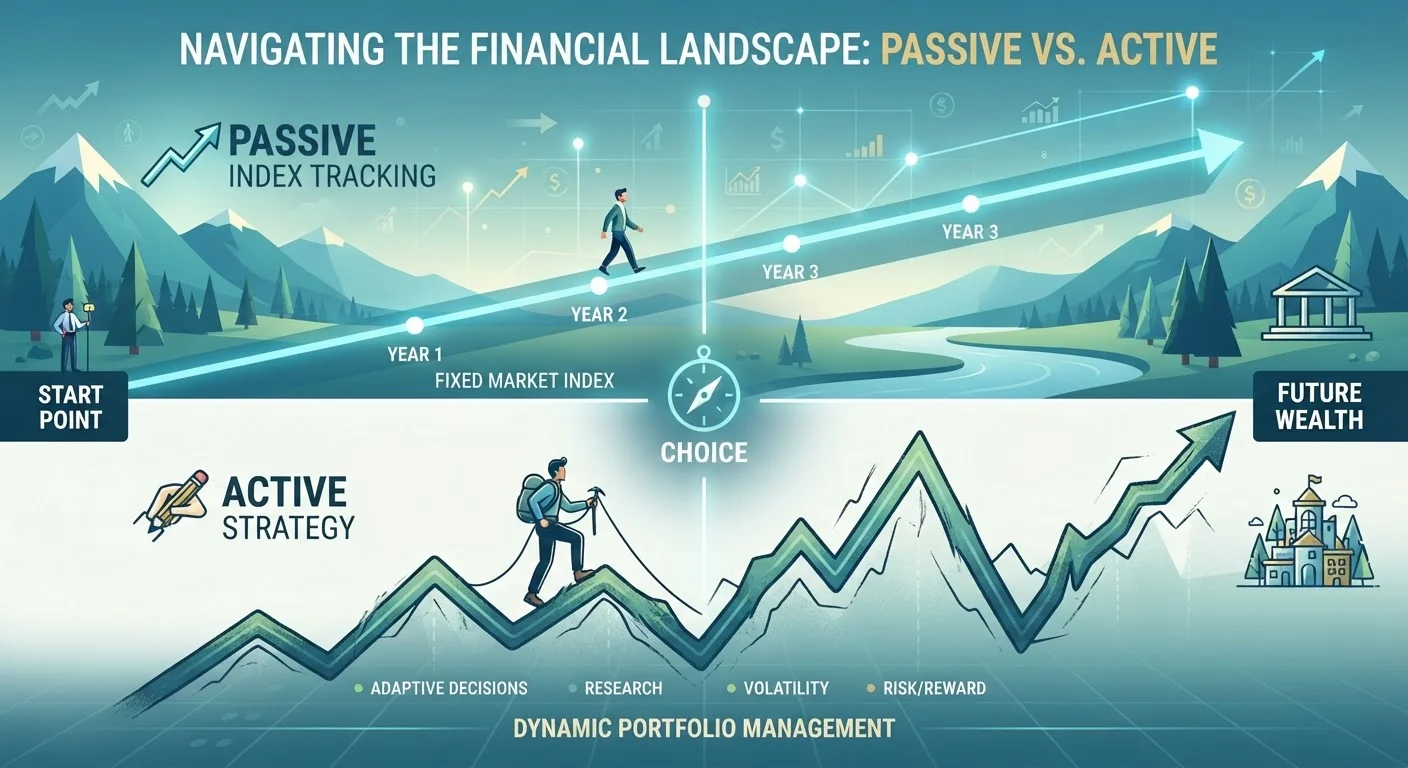
Photo credit: TheBlogZappier.com | Simple Search, Credible Results
In this article
Both index funds and actively managed funds pool investor money, but they work very differently. Understand the key contrasts before deciding which suits your goals.
Key Takeaways
- Index funds track a market benchmark automatically; actively managed funds rely on human judgment to select holdings.
- Actively managed funds typically charge higher fees, which can meaningfully reduce long-term returns.
- Research consistently shows most actively managed funds underperform their benchmark index over the long run.
- Neither approach guarantees a profit — all investing involves risk of loss.
- Your time horizon, cost sensitivity, and comfort with risk should guide which approach fits your situation.
How Each Type of Fund Actually Works
Both index funds and actively managed funds are pooled investment vehicles — meaning many investors contribute money that is then invested across a range of assets. But the way that money gets invested is where they fundamentally differ.
An index fund is designed to mirror a specific market index — such as the S&P 500, which tracks 500 large U.S. companies. The fund buys and holds the same securities as the index in roughly the same proportions. There is no investment team deciding which stocks to pick; the portfolio simply changes when the underlying index changes. This is called passive management.
An actively managed fund, by contrast, employs a portfolio manager (or a team) who researches securities, analyzes market conditions, and makes deliberate decisions about what to buy, hold, or sell. The stated goal is to outperform a benchmark index — not just match it. This is called active management.
If you're still building your foundation, see our explainer on stocks, bonds, and funds to understand what these funds actually hold.
| Criterion | Index Funds | Actively Managed Funds |
|---|---|---|
| Management style | Passive — mirrors an index | Active — human decision-making |
| Typical expense ratio | Very low (often under 0.10%) | Higher (often 0.50%–1.00%+) |
| Goal | Match benchmark returns | Beat benchmark returns |
| Trading frequency | Low — changes when index changes | Higher — manager-driven trades |
| Long-term performance (typical) | Often matches or beats most active peers after fees | Majority underperform index over 10–15 years |
| Transparency | High — holdings mirror public index | Variable — disclosed periodically |
The Cost Difference — and Why It Matters
One of the clearest distinctions between these two fund types is cost, measured by the expense ratio — the annual fee charged as a percentage of your investment. Because index funds require minimal management, their expense ratios tend to be very low, often below 0.10% annually. Actively managed funds must cover research, analyst salaries, and trading activity, so their expense ratios are typically much higher — often between 0.50% and 1.00% or more.
That gap may sound small, but compounded over decades it can make a significant difference to your final balance. A fund charging 1% annually costs ten times more than one charging 0.10%, and that difference comes directly out of your returns.
~85%
Active large-cap funds underperforming S&P 500
According to S&P Dow Jones SPIVA data, roughly 85% of actively managed U.S. large-cap funds underperformed the S&P 500 over a 15-year period after fees.
10x
Potential fee difference between fund types
A fund with a 1.00% expense ratio costs roughly ten times more annually than one with a 0.10% ratio, compounding the gap over decades.
For a plain-language definition of expense ratios and other investing vocabulary, our beginner investing terms guide is a useful companion.
Performance: Can Active Managers Consistently Beat the Market?
The central promise of actively managed funds is outperformance — the idea that skilled managers can identify mispriced securities and generate returns above the benchmark. In practice, the track record is mixed at best.
Large-scale analyses of fund performance — including the widely cited S&P Dow Jones SPIVA reports — have consistently found that the majority of actively managed funds underperform their benchmark index over 10- and 15-year periods, after fees are accounted for. That does not mean active managers never outperform; some do, and some markets may be more amenable to active strategies. But sustained, consistent outperformance is difficult to identify in advance.
It's important to note that past performance does not guarantee future results, and this applies equally to index funds and active funds. All investing carries the risk of loss.
A Note on Fund Selection and Risk
Even within each category, individual funds vary widely in quality, strategy, and risk level. Selecting an index fund does not automatically mean low risk — it depends on what the underlying index tracks. Similarly, not all actively managed funds are alike. Reviewing a fund's prospectus and understanding its holdings is always advisable. When in doubt, a licensed financial adviser can help you evaluate options suited to your goals.
If you're still weighing whether investing is the right move at all, our article on the difference between saving and investing lays out when each approach makes sense.
Choosing Between the Two: What to Consider
There is no universally correct answer — the right choice depends on your personal financial situation, goals, and preferences. Here are the key factors to weigh:
- Cost sensitivity: If keeping fees low is a priority, index funds have a structural advantage.
- Time horizon: Long-term investors generally benefit from the compounding effect of lower annual costs.
- Involvement preference: Index funds require almost no ongoing decision-making from you; active funds also don't require day-to-day attention, but the higher cost means you're trusting a manager's judgment to justify the fee.
- Market type: Some argue active management has a better chance of adding value in less-efficient or specialized market segments.
- Tax considerations: Index funds typically generate fewer taxable events because they trade less frequently — but tax impact varies by account type and individual circumstances. Consult a qualified tax professional for guidance specific to your situation.
Before allocating any money to either fund type, make sure you've addressed more immediate priorities. Our comparison of emergency funds vs. investment accounts can help you think through the right order of operations.
This article is for general informational and educational purposes only and does not constitute personalized financial, investment, or tax advice. All investing involves risk, including the possible loss of principal. Please consult a qualified financial adviser or tax professional before making decisions about your own investments.

Author
Money & Finance Editorial Team
Money & Finance Editorial Team is the collective byline for our editorial team and contributor network. Articles published under this byline or an editorial pen name are researched, written, and reviewed according to our editorial standards for clarity, consistency, and independence before publication.
View all articles →