
Stocks, Bonds, and Funds: Understanding the Three Core Asset Classes
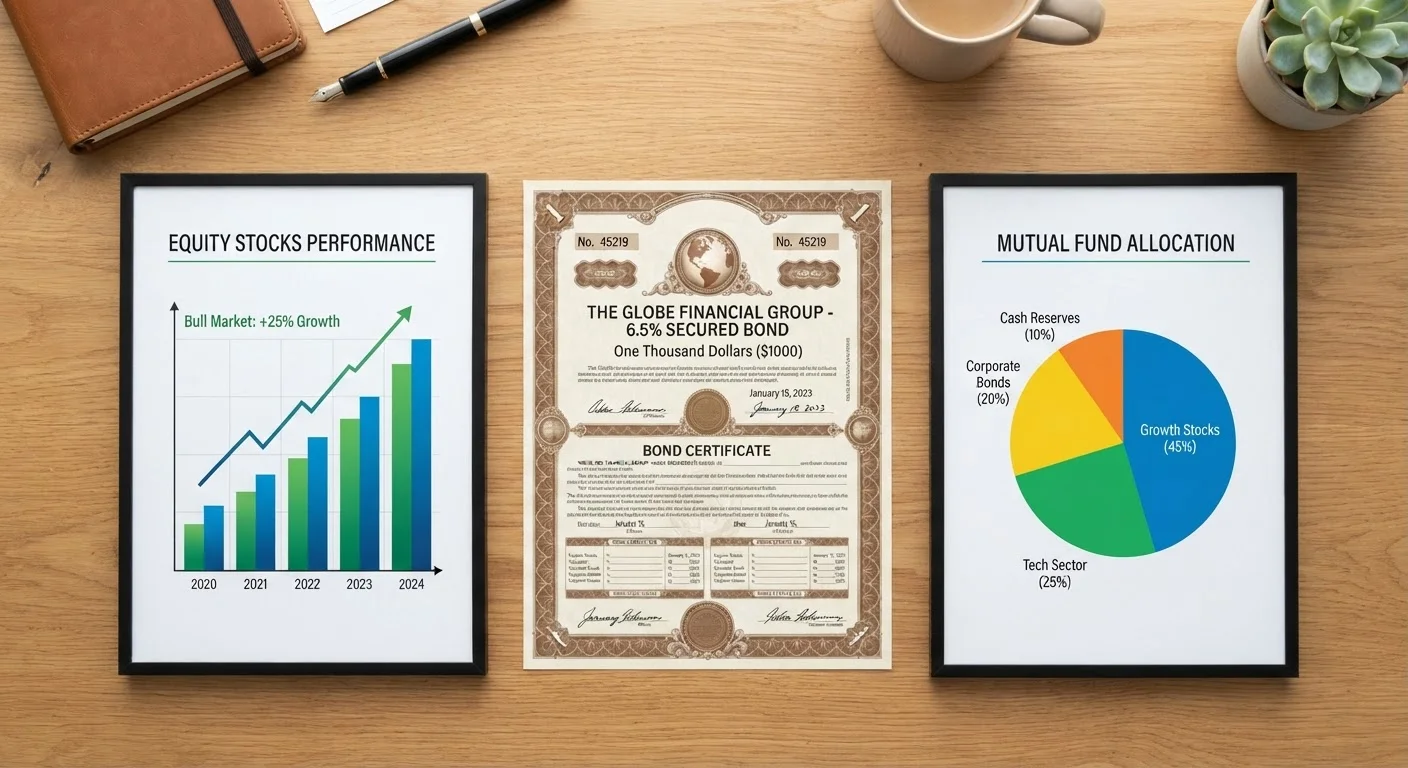
Photo credit: TheBlogZappier.com | Simple Search, Credible Results
In this article
Stocks, bonds, and funds each behave differently in a portfolio. This explainer breaks down what each one is, how it works, and the trade-offs involved.
Key Takeaways
- Stocks represent ownership in a company and carry higher potential returns alongside higher risk.
- Bonds are essentially loans to governments or corporations, generally offering more predictable income with lower risk.
- Funds pool money from many investors to hold a diversified mix of stocks, bonds, or both.
- Each asset class behaves differently — understanding their trade-offs is key to building a balanced portfolio.
- No single asset class suits every situation; your goals, timeline, and risk tolerance all matter.
What Are Stocks, Bonds, and Funds?
Before comparing these three asset classes, it helps to understand what each one actually is. If you're new to investing terminology, the glossary of common investing terms is a useful starting point.
Stocks (also called equities or shares) represent a fractional ownership stake in a company. When you buy a share of stock, you become a part-owner of that business and participate in its successes — and its setbacks. Stock prices fluctuate based on company performance, investor sentiment, and broader economic conditions.
Bonds are debt instruments. When a government or corporation needs to borrow money, it may issue bonds to investors. In exchange, the issuer promises to pay a fixed rate of interest (called a coupon) over a set period and return the original amount (called the principal) at maturity. Bonds behave more like a loan you extend than a business you co-own.
Funds — including mutual funds and exchange-traded funds (ETFs) — pool money from many investors to purchase a collection of securities. Rather than selecting individual stocks or bonds yourself, you buy into a fund that holds dozens or hundreds of them. This structure makes diversification accessible even with modest amounts of money.
How Each Asset Class Works in a Portfolio
Understanding the mechanics of each asset class helps clarify why they're often held together rather than in isolation.
Stocks grow in value when the underlying companies grow. Over long time horizons, equities have historically outpaced inflation and other asset classes — but that performance comes with significant short-term volatility. A portfolio of only stocks can experience sharp declines during economic downturns, which is difficult to absorb if you need the money soon.
Bonds tend to move differently from stocks. When stock markets fall, investors often move money into bonds, which can push bond prices up. This inverse relationship — while not guaranteed — is one reason bonds are used to cushion a portfolio's overall volatility. The trade-off is that bonds typically offer lower long-term returns than stocks.
Funds bring structure and instant diversification. An index fund tracking a broad market index, for example, holds hundreds of companies across industries, reducing the impact any single company's failure would have on your overall investment. For a deeper look at how index funds compare to actively managed funds, see this plain-language comparison.
| Stocks | Bonds | Funds | |
|---|---|---|---|
| What you own | Shares in a company | Debt issued by a borrower | A basket of securities |
| Typical return driver | Company growth & profits | Fixed interest payments | Underlying holdings |
| Risk level | Higher volatility | Generally lower volatility | Varies by fund type |
| Income generation | Dividends (not guaranteed) | Regular coupon payments | Distributions from holdings |
| Diversification | Low (single company) | Low (single issuer) | High (many securities) |
| Best suited for | Long-term growth goals | Income or capital preservation | Beginners or all investors |
| Ongoing cost | Trading commissions may apply | Trading commissions may apply | Annual expense ratio fee |
It's also worth noting the difference between saving and investing before committing money to any asset class. The distinction between saving and investing shapes which tools are appropriate for your goals.
Key Trade-Offs to Understand
Every asset class involves a risk-reward trade-off. There is no option that is simultaneously high-return, low-risk, and fully liquid — understanding which qualities matter most to you is central to making informed decisions.
Match Your Asset Mix to Your Timeline
A common rule of thumb is to hold more stocks when your investment horizon is long and shift toward bonds as you approach a financial goal — such as retirement. This isn't a universal prescription, but it reflects the general principle that time in the market helps offset short-term volatility. A licensed financial adviser can help you determine an appropriate mix for your specific situation.
Risk and return: Stocks carry higher potential returns over long periods, but also higher volatility. Bonds offer more predictable income but limited growth. Funds inherit the risk profile of whatever they hold — a stock fund is riskier than a bond fund.
Time horizon: Stocks are generally considered more appropriate for long-term goals (10 or more years) because you have time to ride out market downturns. Bonds can suit shorter-term goals where preserving capital matters more than maximising growth.
Costs: Individual stocks and bonds can be purchased through brokerage accounts, but selecting them well requires research. Funds charge an expense ratio — an annual fee expressed as a percentage of assets — which varies widely. Lower costs generally favour the investor over time.
Diversification: Holding a single stock concentrates your risk in one company. A diversified fund spreads that risk broadly. For context, think of diversification like insurance — it doesn't prevent all losses, but it limits how much any single event can affect you. See how that logic applies across financial planning in our budgeting basics hub.
This article is for general informational and educational purposes only and does not constitute personalised financial, investment, tax, or legal advice. All investing involves risk, including the possible loss of principal. Past performance does not guarantee future results. Please consult a qualified financial adviser before making investment decisions based on your individual circumstances.

Author
Money & Finance Editorial Team
Money & Finance Editorial Team is the collective byline for our editorial team and contributor network. Articles published under this byline or an editorial pen name are researched, written, and reviewed according to our editorial standards for clarity, consistency, and independence before publication.
View all articles →