
Liability Coverage Across Insurance Types: A Unified Explanation
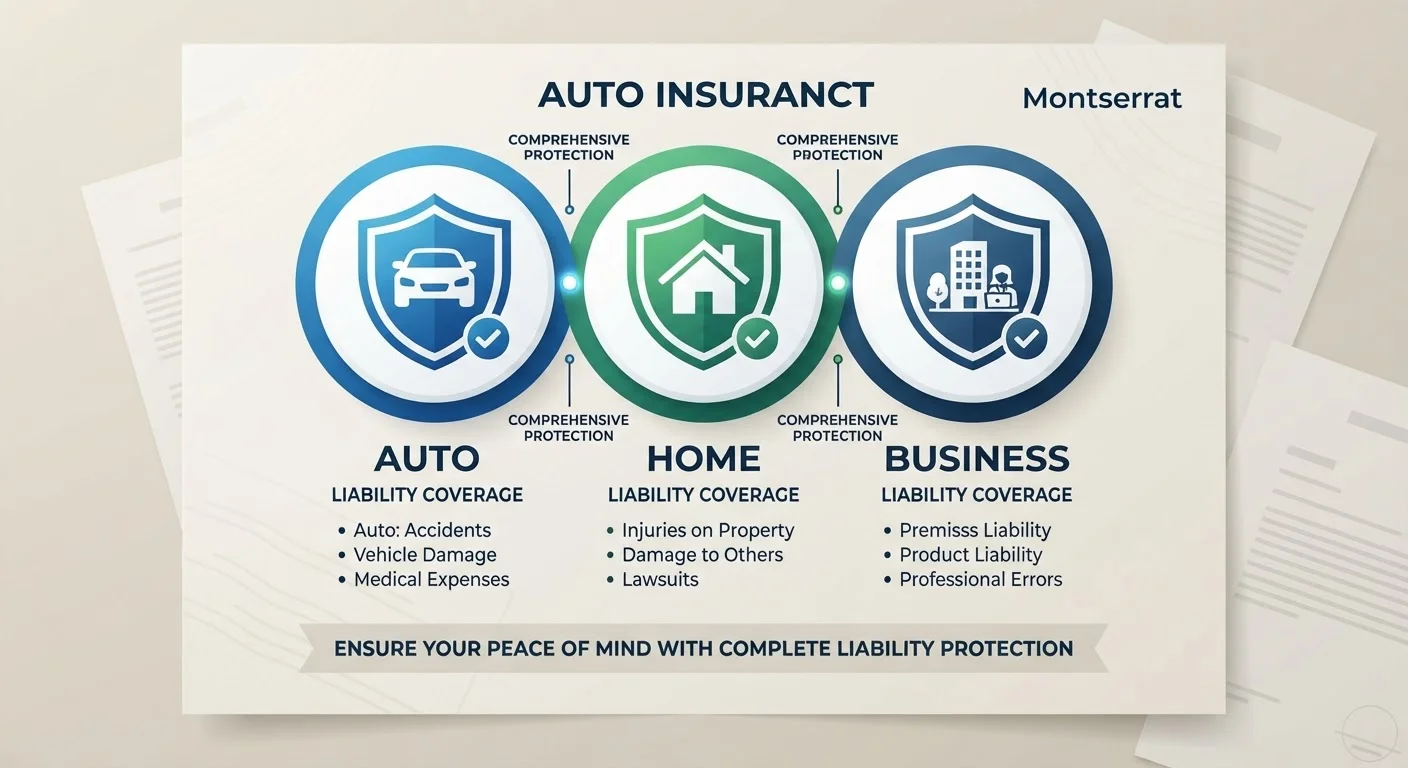
Photo credit: TheBlogZappier.com | Simple Search, Credible Results
In this article
Liability coverage appears in auto, home, and business policies — but it works differently in each. Here's how to read it across contexts.
Key Takeaways
- Liability coverage pays for damage or injury you cause to others - not your own losses.
- Auto, homeowners, and business policies each include liability, but the triggers and limits differ.
- Most liability coverage includes legal defense costs in addition to settlement or judgment amounts.
- Policy limits define the maximum the insurer will pay; costs beyond those limits fall to you.
- An umbrella policy can extend liability protection across multiple underlying policies.
What Liability Coverage Is - and What It Isn't
Liability coverage is a foundational concept that appears in nearly every major insurance category, yet it is often misunderstood because the word "liability" alone doesn't tell you much without context. At its core, liability coverage is about legal responsibility: it activates when you are found responsible for harming another person or damaging their property.
This is the key distinction separating liability coverage from other policy components. Collision coverage on an auto policy pays to fix your car. Medical payments coverage pays your hospital bills. Liability coverage, by contrast, is entirely outward-facing - it protects the other party from your mistakes, and protects you from the financial consequences of being held responsible.
Most liability coverage includes two core components: bodily injury liability, which covers physical harm to another person, and property damage liability, which covers damage to another person's belongings or property. Legal defense costs - attorney fees, court costs - are also typically covered, often in addition to the stated policy limits rather than subtracted from them, though this depends on the specific policy language.
Liability Coverage Does Not Protect Your Own Losses
A common misconception is that liability coverage works both ways in a claim. It does not. Liability coverage is solely for the other party's losses when you are at fault. Your own injuries, vehicle damage, or property losses require separate coverage types - such as collision, comprehensive, or health insurance - depending on the situation.
See our explanation of coverage limits vs. liability limits for a deeper look at how those numbers function at claim time.
Liability in Auto Insurance
Auto liability coverage is the most widely encountered form because most U.S. states require drivers to carry a minimum amount as a condition of legally operating a vehicle. When you cause a car accident, your auto liability coverage pays for the other driver's medical costs, lost wages, and vehicle repairs - not your own.
Auto policies typically express liability limits in a split format - for example, 100/300/100 - meaning $100,000 per injured person, $300,000 per accident for all injuries combined, and $100,000 for property damage. Understanding these numbers matters because a serious accident can quickly reach or exceed state-mandated minimums, which are often quite low.
For a full breakdown of how auto liability fits alongside collision, comprehensive, and other coverage types, see this field guide to auto coverage or the plain-language overview of car insurance coverage types.
~50 states
U.S. states requiring auto liability insurance
Nearly all U.S. states mandate that drivers carry minimum auto liability coverage as a condition of vehicle registration or operation on public roads.
$100,000
Common default homeowners liability limit
Many standard homeowners policies include $100,000 in personal liability coverage by default, though higher limits are typically available.
$1 million+
Typical personal umbrella policy increment
Personal umbrella policies are commonly sold in $1 million increments, providing excess liability protection above underlying auto and homeowners limits.
Liability in Homeowners Insurance
Homeowners policies include a personal liability section that works differently from auto liability in one important way: it covers a broad range of personal liability situations, not just incidents on your property. If your dog bites a neighbor, a guest slips on your icy steps, or your child accidentally breaks an expensive item at someone's home, your homeowners liability coverage may respond.
The standard homeowners liability limit is often $100,000, though policyholders can typically increase this for a relatively modest premium adjustment. Medical payments to others - sometimes called "med pay" - is a related but separate feature that pays small medical bills for injured guests regardless of fault, usually in amounts of $1,000 to $5,000.
Important exclusions apply. Homeowners liability does not cover intentional acts, business-related incidents conducted from the home, or liability arising from the use of motor vehicles. Reading your declarations page carefully reveals the exact scope of your coverage.
Liability in Business Insurance
Businesses face liability exposures that personal policies are not designed to address. Commercial general liability (CGL) insurance is the standard starting point for most businesses. It covers bodily injury and property damage claims arising from business premises, operations, and - in some forms - products or completed work.
Beyond CGL, several specialized forms of business liability exist. Professional liability (sometimes called errors and omissions, or E&O) covers claims that your professional services caused a client financial harm. Product liability addresses claims tied to goods your business manufactures or sells. Directors and officers (D&O) liability protects company leadership against claims related to their management decisions.
Personal auto and homeowners policies explicitly exclude business activities, which means operating a business - even a small home-based one - without appropriate commercial coverage creates a significant gap. Consulting a licensed insurance professional is the appropriate step when assessing business liability needs, as exposures vary widely by industry, size, and location.
How Umbrella Policies Connect the Pieces
A personal umbrella policy sits above your existing auto and homeowners liability limits, providing an additional layer of coverage - typically in increments of $1 million - that activates once your underlying policy limits are exhausted. This makes umbrella coverage a practical way to increase liability protection without rewriting each individual policy.
Umbrellas generally require you to maintain specified minimum liability limits on your underlying policies before they will respond to a claim. They also cover some liability scenarios that standard policies exclude, such as certain defamation claims. Business umbrella or excess liability policies serve a similar purpose for commercial exposures.
For a broader orientation to how liability fits within the overall structure of insurance, the main insurance coverage categories explained provides useful context. And if you are exploring coverage types that work very differently from liability - such as life insurance - life insurance coverage types at a glance offers a clear comparison.
This article is for general informational and educational purposes only and does not constitute personalized insurance, legal, or financial advice. Coverage terms, exclusions, limits, and regulations vary by provider, policy, and state. Always read your policy documents carefully and consult a licensed insurance professional for guidance specific to your situation.
Frequently Asked Questions

Author
Insurance Basics Editorial Team
Insurance Basics Editorial Team is the collective byline for our editorial team and contributor network. Articles published under this byline or an editorial pen name are researched, written, and reviewed according to our editorial standards for clarity, consistency, and independence before publication.
View all articles →