
Reading a VIN: What Your Vehicle Identification Number Actually Contains
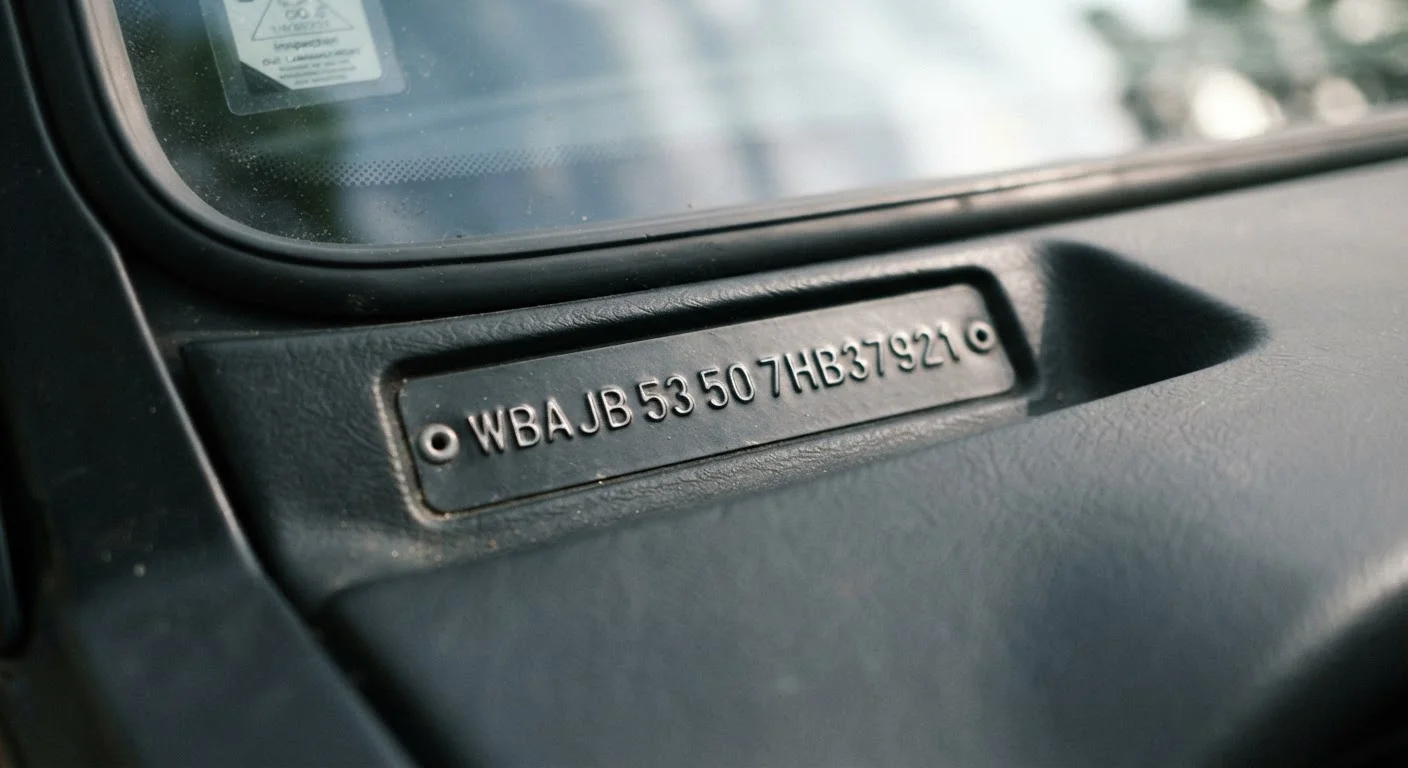
Photo credit: TheBlogZappier.com | Simple Search, Credible Results
In this article
Every digit in a VIN carries meaning. Learn how to decode your car's unique identifier and what information it holds.
Key Takeaways
- A VIN is always exactly 17 characters and follows a standardized international structure.
- Each position encodes specific data - from country of manufacture to the model year.
- Position 9 is a mathematical check digit used to flag fraudulent or misrecorded VINs.
- Your VIN appears on the dashboard, door jamb, vehicle title, and insurance card.
- Free VIN lookup tools can decode and pull vehicle history reports in seconds.
What a VIN Is and Why It Matters
A VIN is a 17-character code assigned to every motor vehicle manufactured for sale in the United States since 1981. Think of it as a fingerprint: no two vehicles share the same VIN. The National Highway Traffic Safety Administration (NHTSA) standardizes the format, which means the code follows a consistent structure regardless of where the car was built.
Understanding your VIN gives you direct access to key facts about a vehicle's history and specifications - without relying on a seller's word. It's the foundation of used-car research, insurance underwriting, and recall tracking. If you're new to automotive terminology, our automotive jargon guide explains many of the terms you'll encounter when researching a car.
Your VIN appears in several places: stamped on a metal plate visible through the lower-left corner of the windshield (driver's side), on a sticker inside the driver's door jamb, and printed on your vehicle title, registration, and insurance card.
What you will need
Breaking Down the 17 Characters
The VIN is divided into three logical sections. Understanding each one turns a random-looking string into readable data.
Characters 1-3: World Manufacturer Identifier (WMI)
The first character identifies the country of manufacture. For example, vehicles assembled in the United States begin with 1, 4, or 5; those from Japan begin with J; Germany with W. The second and third characters narrow down the manufacturer and vehicle type within that country.
Characters 4-8: Vehicle Descriptor Section (VDS)
This five-character block describes the vehicle's attributes - body style, engine type, restraint systems, and model. The exact meaning of each position varies by manufacturer, so a VDS decoder or the automaker's published legend is needed for precise interpretation.
Character 9: The Check Digit
Position 9 is a mathematically derived value. NHTSA uses a specific algorithm - assigning numeric values to each character, multiplying by positional weights, then dividing by 11 - to produce this digit. If a VIN's check digit doesn't validate, the number has likely been altered or recorded incorrectly. This is a critical fraud-detection tool when evaluating a used vehicle.
A Failed Check Digit Is a Red Flag
If a VIN's ninth character doesn't match the result of NHTSA's validation algorithm, the number may have been tampered with, recorded incorrectly, or cloned from another vehicle. This is especially concerning on used vehicles. Always validate the check digit and compare the VIN physically stamped on the car against all documents before completing any purchase.
Characters 10-17: Vehicle Identifier Section (VIS)
Character 10 encodes the model year using a standardized letter/number key (for example, K = 2019, L = 2020, M = 2021). Character 11 identifies the manufacturing plant. Characters 12-17 form the sequential production number - the vehicle's unique serial within that plant for that model year.
How to Decode Your VIN Step by Step
Follow these steps to read your own VIN accurately. You don't need any special tools - just the number itself and a reliable lookup resource.
Locate your VIN
Find the VIN on the metal plate at the base of the windshield on the driver's side, or on the sticker inside the driver's door jamb. Write it down exactly as it appears - all 17 characters. VINs use only capital letters and numbers; the letters I, O, and Q are excluded to avoid confusion with 1 and 0.
Identify the World Manufacturer Identifier (characters 1-3)
Write out just the first three characters. The first tells you the country of final assembly; the second and third identify the manufacturer division. Cross-reference these against NHTSA's published WMI database if you want the precise assignment.
Read the model year from character 10
Locate the tenth character. Use NHTSA's model year key to translate it: letters A-H cover 1980-1987, then J-N skip I, P covers 1993, R-Y (skipping Q) run through 2000, and 1-9 then A-H cycle again from 2001 onward. This single character confirms the model year regardless of what a seller states.
Validate the check digit (character 9)
Use NHTSA's VIN decoder or a reputable automotive database to verify that position 9 is mathematically consistent with the rest of the VIN. These tools run the algorithm automatically. A failed check digit means the VIN is invalid and warrants further investigation.
Run the full VIN through an official lookup tool
Enter your complete 17-character VIN into NHTSA's free decoder at nhtsa.gov or the NICB's VINCheck tool. The results will display recall status, theft records, and decoded specifications. For a full vehicle history report including ownership and accident data, government-linked databases and established history reporting services can provide additional detail.
Using VIN Data in Real Decisions
Once decoded, your VIN unlocks practical information. The NHTSA's free VIN lookup tool (available at nhtsa.gov) shows open safety recalls tied to your vehicle. The National Insurance Crime Bureau's (NICB) VINCheck service flags theft and total-loss records. Many state DMV portals also accept a VIN to verify title status.
When reviewing a used vehicle, cross-referencing the VIN on the dashboard plate against the door jamb sticker and the title confirms the numbers haven't been swapped - a sign of potential fraud or a salvage title cover-up. Mismatched VINs are a serious red flag.
Keep Your VIN Accessible
Store a photo of your VIN in your phone or a cloud document alongside your registration and insurance card. You'll need it quickly if your vehicle is stolen, if a recall notice arrives, or when shopping for replacement parts. Having it on hand avoids a trip back to the car every time a service provider asks.
VIN data also feeds directly into maintenance planning. Knowing your exact engine code and assembly plant can help you identify which service intervals and parts specifications apply to your specific build. For a deeper look at how to use that information, see our guide on what vehicle maintenance records reveal and how to interpret your car's maintenance schedule.
If you enjoy decoding the numbers on your vehicle, you may also find it useful to understand tyre sidewall markings, which follow a similar logic of encoded specifications.

Author
Autos & Driving Editorial Team
Autos & Driving Editorial Team is the collective byline for our editorial team and contributor network. Articles published under this byline or an editorial pen name are researched, written, and reviewed according to our editorial standards for clarity, consistency, and independence before publication.
View all articles →