
Reading a Clothing Label Without Losing Your Mind
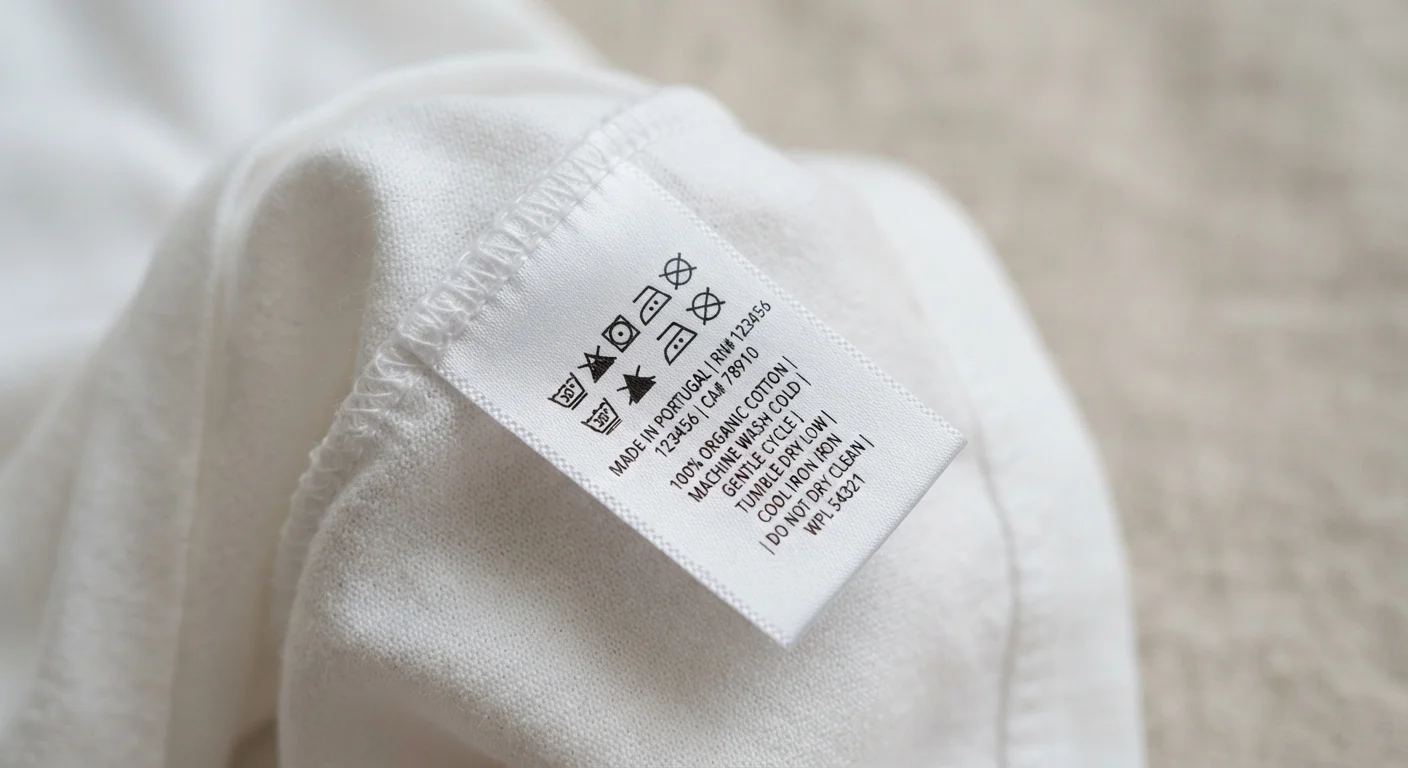
Photo credit: TheBlogZappier.com | Simple Search, Credible Results
In this article
Care symbols, fibre percentages, country of origin — this guide explains exactly what clothing labels tell you and why it matters.
Key Takeaways
- Clothing labels in the US must by law include fibre content, care instructions, and country of origin.
- Care symbols follow an internationally standardized system — learning the five base icons covers most garments.
- Fibre percentages directly affect how a garment wears, breathes, and holds its shape over time.
- Ignoring care instructions is the most common reason clothes shrink, fade, or distort after washing.
- Country-of-origin information tells you where a garment was assembled, not necessarily where fibres originated.
What the Law Requires on Every Label
In the United States, clothing labels are regulated by the Federal Trade Commission (FTC) under the Textile Fiber Products Identification Act and the Care Labeling Rule. These regulations require that garments sold in the US include three core pieces of information: fibre content (by percentage), country of origin (where the garment was assembled), and care instructions (either in symbols, words, or both). Manufacturer or dealer identity must also appear. Understanding this baseline helps you know what you're entitled to find on any label — and when information is genuinely missing versus just difficult to read.
Labels are also where sizing is communicated, though sizing conventions vary widely by brand and by region. If you regularly shop across international brands, our guide to clothing sizing systems around the world provides useful reference tables.
Dry Clean Only Is Not a Suggestion
When a label reads "Dry Clean Only," washing the garment at home — even on a delicate cycle — can permanently damage the fabric structure, cause shrinkage, or strip surface finishes. This instruction exists because the fabric or construction cannot safely tolerate water immersion. If a garment is labeled this way, plan for professional cleaning before you buy, not after.
How to Read the Label: Step by Step
Most label confusion comes from unfamiliar symbols or abbreviations. The steps below walk you through each section of a typical care label in the order that's most useful at the point of purchase and again at laundry time.
What you will need
ASTM/AATCC Care Symbol Reference Chart
A standardized chart that decodes laundry symbols used on US clothing labels — available free from textile industry bodies.
Magnifying glass or smartphone camera
Helps read small or faded label text accurately without guessing.
Locate all labels on the garment
Most garments carry two types of labels: a brand or size label sewn at the neckline or waistband, and a care label typically stitched at an interior seam — the side seam or hem are common placements. Some garments combine both on a single label. Check both locations before assuming a garment has no care information.
Read the fibre content percentage
US federal law (enforced by the FTC) requires that clothing labels list fibre content by percentage, in descending order. A label reading 60% cotton, 35% polyester, 5% elastane tells you the dominant material first. Fibre composition affects breathability, durability, stretch, and how the garment responds to washing. For a deeper look at how individual fibres behave, see our guide on natural fibres vs. synthetic fabrics.
Decode the care symbols
Care symbols are standardized across five categories, each represented by a base icon:
- Washtub — washing instructions (machine or hand wash; dots indicate temperature)
- Triangle — bleaching (solid triangle means any bleach; crossed out means no bleach)
- Square with circle — tumble drying (dots inside indicate heat level)
- Iron — ironing temperature (dots = low/medium/high heat)
- Circle — dry cleaning (letters inside specify solvent type for professionals)
A line beneath any symbol indicates a gentler setting. An X through any symbol means that process is prohibited entirely.
Note the country of origin
US law also requires labels to state the country where the garment was assembled. This is not necessarily where the raw fibres were grown or where the fabric was woven — those steps may have occurred in entirely different countries. Country of origin is a regulatory disclosure; it does not, on its own, indicate quality or working conditions.
Check for any written care instructions alongside symbols
Some labels supplement symbols with plain-text instructions: "Wash inside out," "Do not wring," "Iron on reverse side only." These additions address garment-specific concerns that symbols alone cannot capture — such as protecting printed graphics or structured embellishments. Read any text alongside the symbols rather than treating symbols as the complete picture.
Apply the instructions — and store the information
Follow the most restrictive instruction when in doubt: if the label permits machine washing but recommends cold water, use cold. If it permits tumble drying but only on low, don't use high heat to save time. Garment damage from incorrect care is cumulative — it may not be obvious after one wash but will become apparent over time. Understanding care instructions also helps you anticipate how a garment will age, which is useful when deciding whether a purchase makes sense for your wardrobe. Related: why clothes stop fitting even when your size hasn't changed.
Photograph Labels Before Removing Them
If you remove garment tags to avoid irritation, take a quick photo first and store it in a dedicated album on your phone. This preserves the care information you'll need at laundry time. Some shoppers also keep a note with the photo listing where the item is stored.
Faded Labels Are Still Your Responsibility
Over time, printed label text can fade and become illegible. If you can no longer read care instructions, treat the garment as if it were the most delicate version of its fibre content — cool water, gentle cycle, lay flat to dry. When in doubt, hand wash and avoid the dryer entirely.
Why Label Reading Matters Beyond Laundry
Care labels do more than prevent laundry mistakes. Fibre content tells you something meaningful about comfort, longevity, and environmental impact. A 100% linen garment will behave very differently from a linen-polyester blend — in how it drapes, how it wrinkles, and how it softens with repeated washing. Similarly, knowing that a garment requires dry cleaning before you buy it allows you to factor that ongoing cost into your decision.
Labels also support informed wardrobe building. When you understand what you already own — its fibres, its care needs, its origin — you're better positioned to identify gaps and make purchases that actually integrate with the rest of your clothing. For broader context on seasonal wardrobe decisions, the Trends & Seasons hub covers how style considerations shift across the year.
Reading labels is, in a small way, analogous to reading any product information carefully — whether that's a cosmetics ingredient list or a nutrition panel. For a related exercise in label literacy, see our guide on reading a cosmetics ingredient list.

Author
Style & Beauty Editorial Team
Style & Beauty Editorial Team is the collective byline for our editorial team and contributor network. Articles published under this byline or an editorial pen name are researched, written, and reviewed according to our editorial standards for clarity, consistency, and independence before publication.
View all articles →