
Crate Training: What It Is, What It Isn't, and How It Actually Works
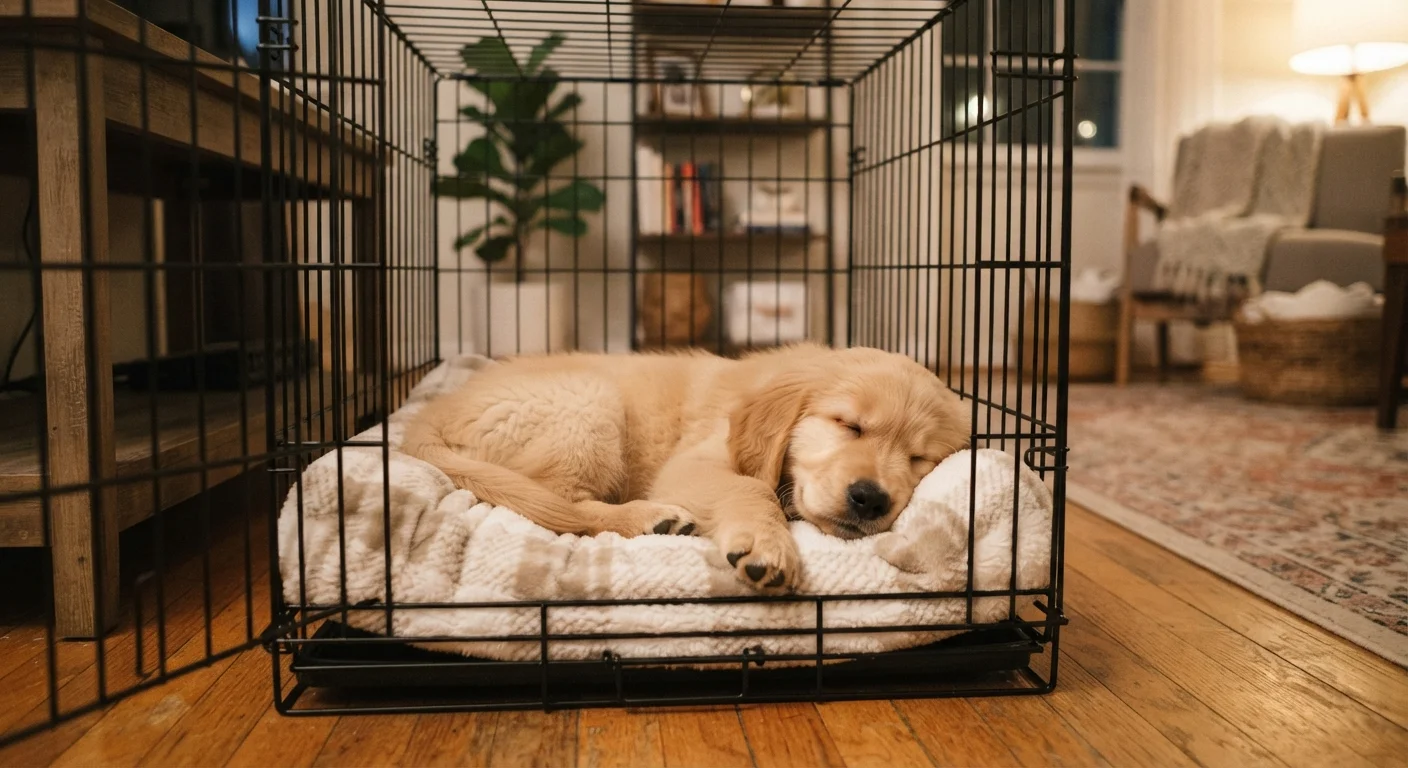
Photo credit: TheBlogZappier.com | Simple Search, Credible Results
In this article
Crate training is widely misunderstood. Understand the behavioural rationale behind it and how to introduce a crate in a way that feels safe for your dog.
Key Takeaways
- Crates work by appealing to a dog's natural preference for small, enclosed resting spaces.
- Confinement used as punishment undermines the crate's purpose and harms the dog's sense of safety.
- Gradual introduction with positive associations is the foundation of successful crate training.
- Most adult dogs should not spend more than four hours continuously inside a crate.
- A crate does not replace exercise, socialisation, or mental enrichment.
The Case for Crate Training — Done Right
Few training tools generate as much debate as the crate. Critics call it cruel confinement; enthusiastic proponents sometimes overuse it. The reality sits somewhere more nuanced: a crate, introduced thoughtfully, can give a dog a private, predictable space in a world that is often overwhelming — especially during the early weeks in a new home.
The behavioural rationale is grounded in what researchers and applied animal behaviourists understand about canine comfort. Dogs, like many mammals, show a preference for small, enclosed spaces when they are tired, anxious, or want to disengage. A properly sized crate — large enough to stand, turn around, and lie down comfortably — can meet that instinct rather than fight it.
Where owners go wrong is rushing the process or using the crate as a default solution to problems it was never designed to fix. This article walks through the most persistent myths about crate training, corrects them with evidence-backed information, and explains what a realistic, humane introduction actually looks like. For broader context on building a settled home life for a new dog, the Pet Care Basics hub covers the essential daily routines that complement any training approach.
Myths, Facts, and the Evidence Behind Them
The misconceptions below are among the most commonly held — and most consequential — when it comes to crate training. Each one, if acted on, can either cause real distress to a dog or cause an owner to abandon a tool that could genuinely help.
Myth
Crating a dog is cruel because it imprisons an animal that wants to roam freely.
Fact
A crate used correctly is not imprisonment — it is a predictable, safe space that aligns with a dog's natural preference for denning.
The idea that all confinement is inherently cruel ignores what behavioural science tells us about how dogs manage stress. Many dogs, when given free access to a crate and the run of a house, will voluntarily choose the crate to sleep or decompress. The problem is not the crate itself — it is forcing a dog inside before it has formed a positive association with the space, or leaving it confined far longer than is appropriate.
Myth
Puppies should be crated as much as possible early on so they learn faster.
Fact
Excessive crating delays learning and can cause anxiety. Puppies need regular interaction, socialisation, and movement to develop normally.
Young puppies have extremely limited bladder control and significant needs for social engagement. Over-crating deprives them of the varied experiences that shape a stable temperament. A general guideline used by many trainers is that puppies can tolerate roughly one hour of crating per month of age, up to a maximum of about four hours — and never overnight beyond what their bladder physically allows. Early socialisation is equally critical; our puppy socialisation framework outlines how to structure those early weeks constructively.
Myth
Once a dog is crate trained, it's fine to leave them in it all day while you're at work.
Fact
Most adult dogs should not be crated for more than four hours at a stretch without a break for movement, toileting, and interaction.
Crating a dog for eight or nine hours routinely is a welfare concern regardless of how well the animal accepts the space. Dogs need physical exercise, mental stimulation, and social contact to stay healthy and behaviorally balanced. Extended daily crating has been associated with frustration, boredom, and the development of repetitive or anxious behaviors. A crate is a management tool for specific periods — not a substitute for adequate care throughout the day.
[stat_highlights]Myth
If a dog whines or protests in the crate, you should ignore it completely so you don't reinforce the behaviour.
Fact
Blanket ignoring is an oversimplification. Distress vocalisations signal that the introduction was too fast — the solution is to slow down, not to wait it out.
There is an important distinction between a dog that whines briefly and then settles (a mild protest that often resolves on its own) and a dog that escalates into sustained barking, panting, or attempts to escape. The latter indicates real distress, not manipulation. Reinforcing calm behaviour when it occurs — rather than waiting until panic peaks — is both more humane and more effective. If commands the dog already knows are breaking down in or around the crate, that is often a sign of underlying stress worth investigating. Our article on why dogs ignore known commands explores what those signals usually mean.
Myth
A bigger crate is always better because the dog has more space.
Fact
A crate that is too large can undermine house training because the dog has room to soil one end and sleep in the other.
Crate size matters particularly during house training. Dogs are less likely to eliminate in a space they must also sleep in — but only if that space is appropriately sized. A crate large enough for a puppy to stand, turn, and lie down is typically sufficient. Many wire crates include dividers that allow owners to expand the usable space as the dog grows, making them a practical and appropriately scaled option across life stages.
How to Actually Introduce a Crate
Successful crate training is a process measured in days and weeks, not hours. The goal is for the dog to associate the crate with rest, calm, and good things — never with isolation as a consequence.
- Start with the door open. Place the crate in a frequented room and let the dog investigate freely. Drop high-value treats near and just inside the entrance without any pressure to enter.
- Feed meals near, then inside, the crate. Gradually move the food bowl closer to the back of the crate over several sessions. Keep the door open throughout.
- Introduce short, voluntary sessions. Once the dog enters comfortably, close the door for 30–60 seconds while you remain present. Open it before any sign of distress, and reward calm behaviour.
- Build duration incrementally. Extend closed-door time gradually — a few minutes, then longer — always pairing it with a long-lasting chew or food-stuffed toy that makes the time enjoyable.
- Never use the crate as punishment. Sending a dog to the crate after undesired behaviour creates a negative association that unravels the training entirely.
For dogs that live in smaller homes, a crate also provides a defined personal territory — something particularly useful in multi-animal environments. See our guide on managing space in multi-pet households for practical setup strategies.
Crating Is Not a Fix for Separation Anxiety
Dogs with true separation anxiety — characterised by sustained distress, destructive behaviour, or self-injury when left alone — often experience increased panic when confined. Crating an anxious dog without addressing the underlying condition can make the problem worse. If your dog shows signs of severe distress when left alone, consult a qualified veterinary behaviourist or certified professional dog trainer before using a crate as a management strategy.
Training a dog to feel comfortable alone in a crate pairs naturally with broader positive reinforcement methods. The evidence on reward-based training is clear: approaches that build positive associations produce more durable, stress-free learning outcomes than those that rely on correction.
This article is for general informational purposes only and does not constitute professional veterinary or animal behaviour advice. For dogs showing signs of severe separation anxiety or distress, consult a qualified veterinary behaviourist or certified professional dog trainer.

Author
Pets & Animals Editorial Team
Pets & Animals Editorial Team is the collective byline for our editorial team and contributor network. Articles published under this byline or an editorial pen name are researched, written, and reviewed according to our editorial standards for clarity, consistency, and independence before publication.
View all articles →