
Secured vs. Unsecured Debt: What Changes When Collateral Is Involved
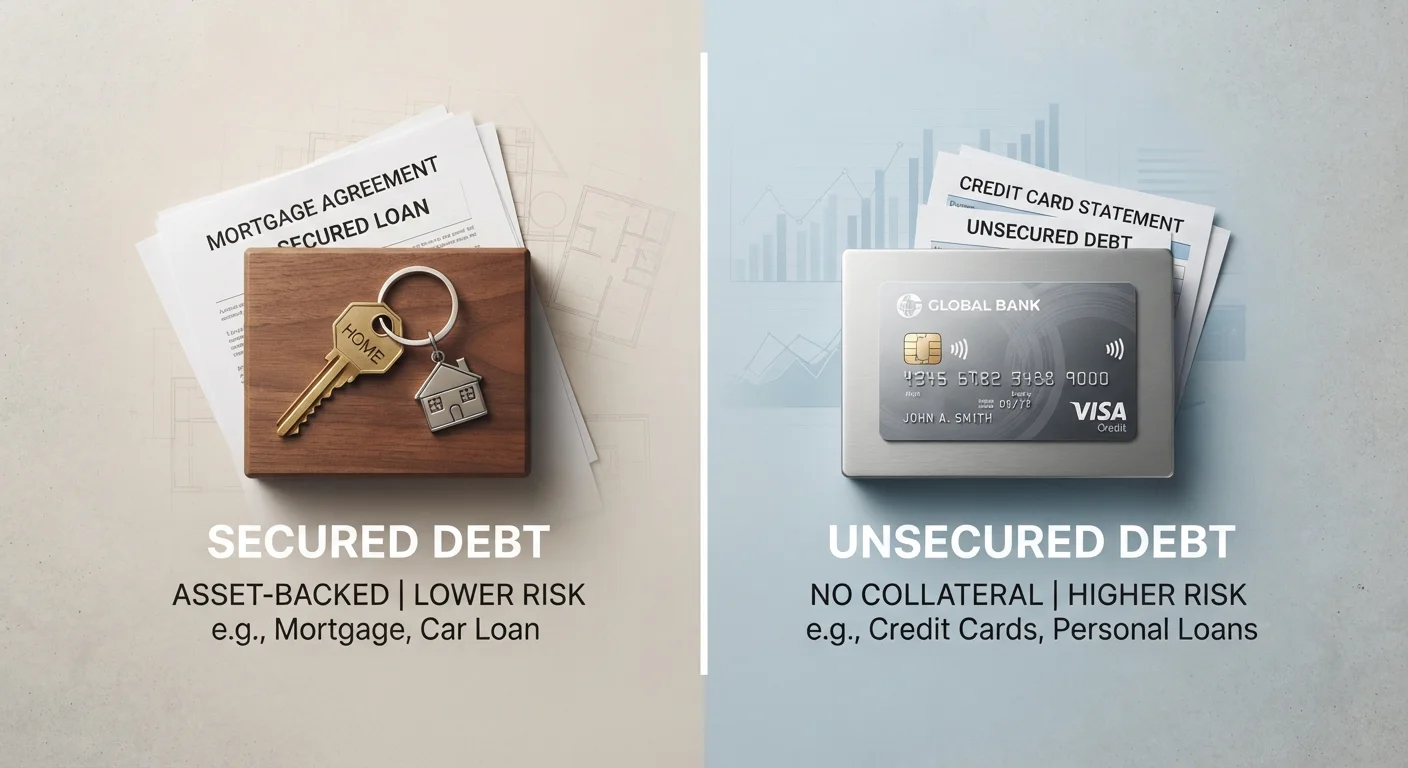
Photo credit: TheBlogZappier.com | Simple Search, Credible Results
In this article
Learn the legal and financial differences between secured and unsecured debt, and what those differences mean for borrowers.
Key Takeaways
- Secured debt requires collateral; the lender can seize that asset if you stop paying.
- Unsecured debt carries no collateral but typically comes with higher interest rates.
- Defaulting on secured debt can result in repossession or foreclosure; unsecured default leads to collection and credit damage.
- Your credit score affects the terms you receive on both types of debt.
- Understanding which type you hold helps you prioritize repayment and manage risk.
What Makes Debt 'Secured' or 'Unsecured'?
At its core, the distinction comes down to one question: does the loan require you to pledge an asset? If so, it is secured debt. If not, it is unsecured debt. That single difference ripples through interest rates, borrower risk, and what happens when payments stop.
With secured debt, the borrower grants the lender a legal claim — called a lien — on a specific asset, known as collateral. A mortgage uses your home as collateral; an auto loan uses the vehicle. If you default, the lender has the legal right to seize and sell that asset to recover the unpaid balance. Unsecured debt carries no such claim. Credit cards, student loans, and personal loans (in most cases) are unsecured — approved on the strength of your credit history and income alone.
If you are new to these concepts, the foundational guide for first-time borrowers covers the building blocks of credit and debt in plain language.
Some Debt Types Blur the Line
Not every loan fits neatly into one category. A secured credit card, for example, requires a cash deposit that acts as collateral — making it technically secured despite looking like a typical card. Home equity loans are secured by your property even though the proceeds can be used for almost anything. Always review your loan agreement to understand whether collateral is involved and what the lender's rights are if you default.
Side-by-Side Comparison
The table below highlights the most practically important differences between secured and unsecured debt across several criteria. Keep in mind that actual terms vary by lender, loan type, and your individual credit profile.
| Criterion | Secured Debt | Unsecured Debt |
|---|---|---|
| Collateral required | Yes (home, car, savings) | No |
| Typical interest rate | Lower | Higher |
| Common examples | Mortgage, auto loan | Credit card, personal loan, student loan |
| Consequence of default | Asset repossession or foreclosure | Collections, credit damage, possible judgment |
| Loan amounts available | Generally larger | Generally smaller |
| Approval basis | Credit + collateral value | Credit score and income only |
| Credit score impact | Yes — payment history reported | Yes — plus utilization on revolving accounts |
Risk Profiles: What Each Type Means for Borrowers
The risk calculus differs sharply depending on which type of debt you carry.
With secured debt, the stakes are concrete. If you miss mortgage payments, you face foreclosure — the legal process through which a lender takes ownership of your home. Miss car payments, and the vehicle can be repossessed, sometimes within days of a missed due date depending on your state. Your credit score also suffers, but the physical loss of an asset is the more immediate consequence.
With unsecured debt, default triggers a different chain of events. The lender may charge off the account (write it off as a loss), sell the debt to a collections agency, and potentially sue for a court judgment. A judgment can lead to wage garnishment or bank account levies in many states. Your credit score takes significant damage, affecting your ability to borrow in the future.
Neither type of default is harmless. But understanding how each plays out helps you prioritize when money is tight. Many financial counselors advise keeping secured debt payments current first, since the consequences of losing a home or car are typically more immediate and harder to reverse.
~$17.7T
Total US household debt
According to the Federal Reserve Bank of New York, total US household debt reached roughly $17.7 trillion as of late 2023, with mortgage debt comprising the largest secured share.
~21%
Average credit card APR
The Federal Reserve reported average credit card interest rates exceeding 21% in 2023, illustrating the higher cost typically associated with unsecured revolving debt.
If you are managing multiple balances, see how the debt snowball and avalanche methods compare to find a structured payoff approach.
Interest Rates, Loan Terms, and Credit Score Impact
Because secured lenders have a safety net in the collateral, they typically offer lower interest rates and longer repayment windows. A mortgage might carry a rate significantly below what a personal loan would charge for the same borrower, simply because the lender's risk is reduced.
Unsecured debt, lacking that safety net, is priced accordingly. Lenders price in the additional risk through higher APRs. Credit cards, for instance, often carry double-digit rates. Borrowers with stronger credit scores generally access better rates on both types, but the gap between a well-qualified and a poorly-qualified borrower is usually steeper on unsecured products.
Both debt types appear on your credit report and affect your score. Payment history — the biggest factor in most scoring models — is influenced equally. However, carrying a high balance relative to your credit limit on unsecured revolving accounts (like credit cards) also raises your credit utilization ratio, which can drag scores down. For a full glossary of terms like utilization, charge-off, and APR, the credit terms reference is a useful bookmark.
If you are considering restructuring what you owe, read about what debt consolidation actually solves before deciding whether to combine balances.
This article is for general informational and educational purposes only and does not constitute personalized financial, legal, or tax advice. Consult a qualified financial professional before making decisions about your specific situation.

Author
Money & Finance Editorial Team
Money & Finance Editorial Team is the collective byline for our editorial team and contributor network. Articles published under this byline or an editorial pen name are researched, written, and reviewed according to our editorial standards for clarity, consistency, and independence before publication.
View all articles →