
How Claims Differ Across Insurance Types: Home, Auto, Health, and More
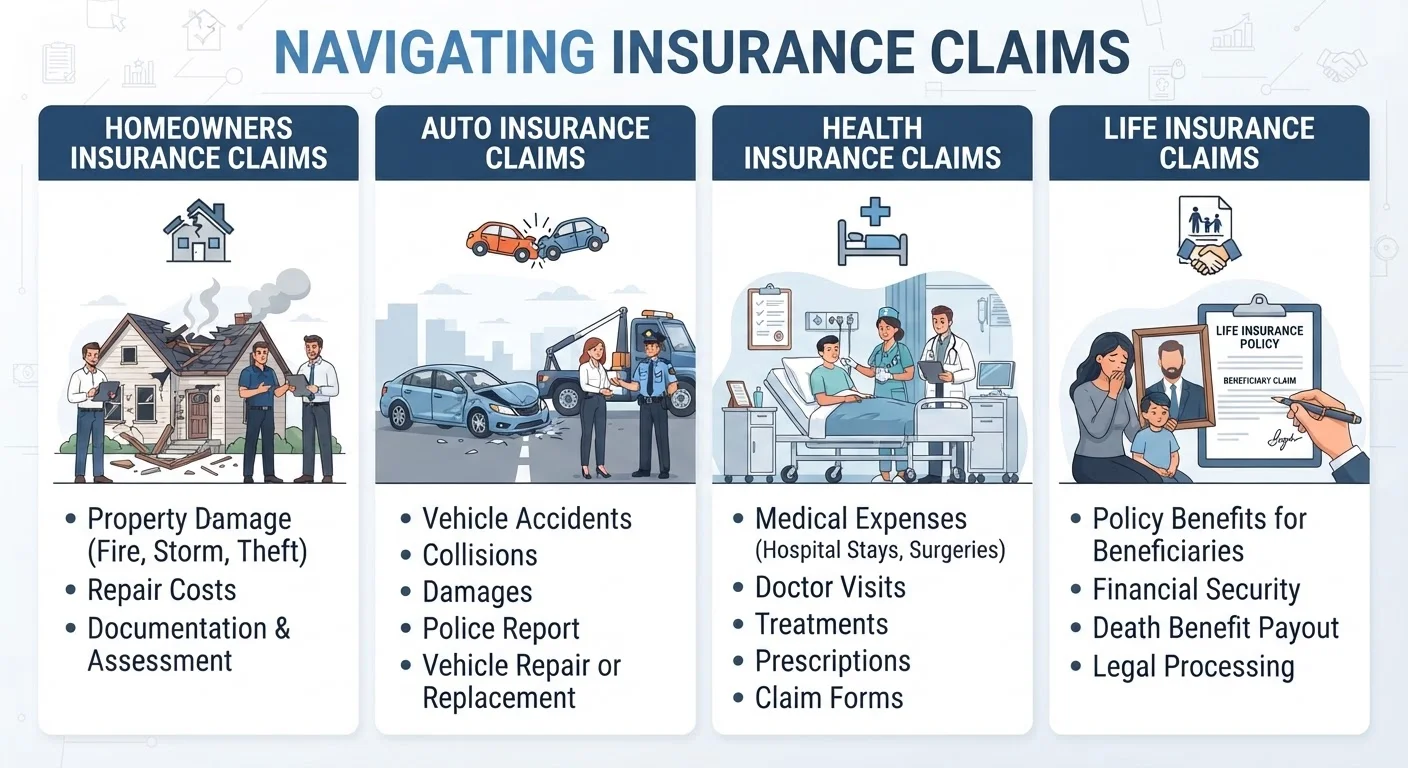
Photo credit: TheBlogZappier.com | Simple Search, Credible Results
In this article
- The Common Framework — and Why It Breaks Down Quickly
- Home Insurance Claims: Inspections, Adjusters, and Repair Timelines
- Auto Insurance Claims: Fault, Third Parties, and Repair Estimates
- Health Insurance Claims: Provider-Filed, Pre-Authorization, and EOBs
- Life Insurance Claims: Beneficiary-Initiated, Documentation-Heavy
The core claims process shares common steps, but home, auto, health, and life insurance each have distinct rules and timelines. Here's how they compare.
Key Takeaways
- All insurance claims share a common skeleton, but the details vary significantly by coverage type.
- Home claims involve property inspections; auto claims may involve fault determinations and repair estimates.
- Health claims are often filed by providers directly, while life insurance claims require a death certificate.
- Timelines, documentation requirements, and who initiates the claim differ across insurance types.
- Understanding these differences helps you respond quickly and avoid costly delays.
The Common Framework — and Why It Breaks Down Quickly
Every insurance claim follows a recognizable core sequence: something happens, you notify your insurer, evidence is gathered, a decision is made, and payment is issued or denied. For a full stage-by-stage breakdown, see the insurance claims process walkthrough.
But that shared skeleton gets filled in very differently depending on the coverage type. The differences aren't minor — they affect who files the claim, what documentation is required, which professionals are involved, and how long you'll wait. Mistaking one type's rules for another's is a common source of frustration and delay.
Before exploring each type, it helps to understand the terminology you'll encounter. Our insurance claims terminology guide defines key terms like deductible, adjuster, subrogation, and assignment of benefits in plain language.
Home Insurance Claims: Inspections, Adjusters, and Repair Timelines
When your home or personal property is damaged — by fire, storm, theft, or another covered peril — the claims process is driven largely by physical inspection. After notifying your insurer, a claims adjuster (either employed by the insurer or independent) will visit the property to assess the damage and estimate repair or replacement costs.
Key features of home claims:
- You initiate the claim. Your insurer won't know about a burst pipe or wind damage unless you report it.
- Documentation is critical. Photos, a home inventory, and receipts for damaged items all strengthen your position.
- Actual cash value vs. replacement cost. Depending on your policy, your payout may reflect depreciation or the full cost of replacement — a significant difference on large claims.
- Timelines vary widely. Simple claims may close in weeks; storm damage affecting many policyholders in the same area can take months.
If you're unsure whether your insurer's adjuster is representing your interests, see our explainer on public adjusters vs. insurer's adjusters.
| Home Insurance | Auto Insurance | Health Insurance | Life Insurance | |
|---|---|---|---|---|
| Who files the claim | Policyholder | Policyholder or at-fault party | Usually the provider | Beneficiary |
| Key documentation | Photos, home inventory, receipts | Police report, repair estimates | Medical records, billing codes | Death certificate, claim form |
| Third-party involvement | Property adjuster | Other driver's insurer | Healthcare provider | None typically |
| Typical timeline | Weeks to months | Days to weeks | Days to weeks | Weeks to months |
| Common denial reasons | Excluded peril, late filing | Disputed fault, lapsed coverage | Not pre-authorized, out-of-network | Contestability period, misrepresentation |
| Payout method | Check or direct repair payment | Repair payment or cash | Payment to provider or reimbursement | Lump sum or installments |
Auto Insurance Claims: Fault, Third Parties, and Repair Estimates
Auto claims add a layer of complexity that home claims usually don't: the question of fault. In an accident involving multiple vehicles, insurers must determine who is liable — and that determination shapes who pays whom.
This is where the distinction between first-party and third-party claims becomes important. If you're claiming under your own collision coverage, that's a first-party claim. If you're claiming against the at-fault driver's liability policy, you're a third-party claimant. The first-party vs. third-party claims guide explains how these paths differ in practice.
Other auto-specific features include:
- Repair estimates are usually obtained from approved body shops or through an insurer-assigned appraiser.
- Rental reimbursement may be available if your policy includes it, but typically only while your vehicle is being repaired.
- Total loss determinations occur when repair costs exceed a threshold percentage of the vehicle's actual cash value.
Health Insurance Claims: Provider-Filed, Pre-Authorization, and EOBs
Health insurance claims work differently from property-based claims in one fundamental way: most of the time, your healthcare provider files the claim for you. When you receive treatment, the provider submits a claim to your insurer directly, coding each service with standardized billing codes.
Always Review Your EOB Carefully
Billing errors in healthcare are more common than most people realize. When you receive an Explanation of Benefits, compare it against your own records of the care you received. If the codes or amounts look unfamiliar, contact your provider's billing department before paying anything. Disputing an error is far easier before a balance goes to collections.
What you receive is an Explanation of Benefits (EOB) — a document showing what was billed, what the insurer paid, and what you owe. The EOB is not a bill, but it's essential for catching billing errors.
Key features of health claims:
- Pre-authorization may be required for certain procedures before you receive care; skipping this step can result in denied coverage.
- In-network vs. out-of-network status significantly affects your out-of-pocket costs.
- Appeals are common and often successful — if a claim is denied, you generally have the right to appeal the decision.
For a broader understanding of how health insurance fits within the coverage landscape, see the main insurance coverage categories explained.
Life Insurance Claims: Beneficiary-Initiated, Documentation-Heavy
Life insurance claims are unique because the policyholder cannot file the claim themselves. Instead, the named beneficiary initiates the process after the policyholder's death. The insurer requires a certified copy of the death certificate and a completed claim form at minimum; additional documentation may be requested depending on the circumstances and cause of death.
Important distinctions in life claims:
- Contestability period: Most policies include a two-year contestability window during which the insurer can investigate and potentially deny claims based on misrepresentation on the original application.
- Payout options: Beneficiaries may be able to choose between a lump sum, installments, or an annuity — each with different financial implications.
- Accidental death riders may provide additional benefits but require separate documentation proving the manner of death.
Understanding term life vs. whole life insurance also matters at the claims stage, since the two structures handle cash value and benefit calculations differently.
This article is for general informational and educational purposes only and does not constitute personalized insurance, legal, or financial advice. Coverage terms, claim procedures, and timelines vary by insurer, policy, and state. Always consult your policy documents and a licensed insurance professional for guidance specific to your situation.

Author
Insurance Basics Editorial Team
Insurance Basics Editorial Team is the collective byline for our editorial team and contributor network. Articles published under this byline or an editorial pen name are researched, written, and reviewed according to our editorial standards for clarity, consistency, and independence before publication.
View all articles →