
Term Life vs. Whole Life Insurance: What Sets Them Apart
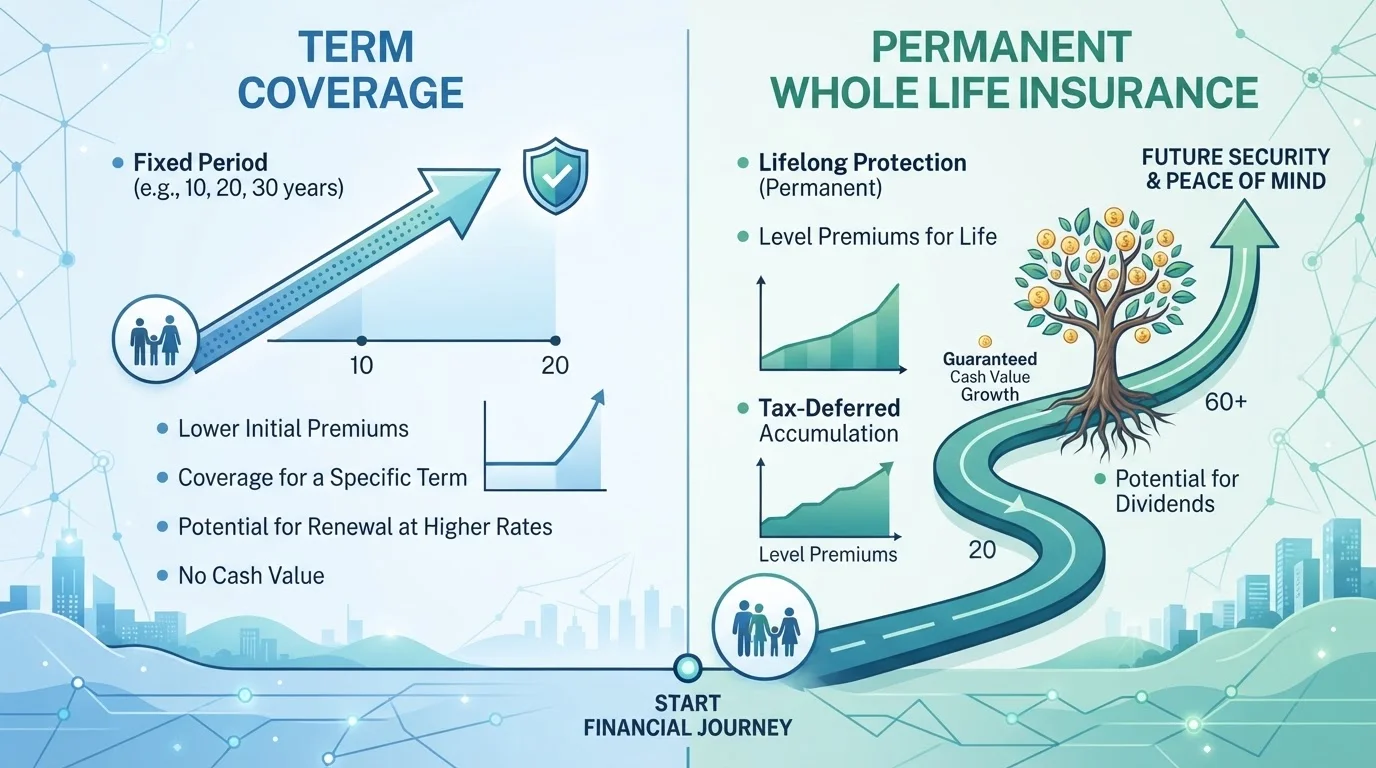
Photo credit: TheBlogZappier.com | Simple Search, Credible Results
In this article
Term and whole life insurance work very differently. Understand the structural differences before deciding which type fits your situation.
Key Takeaways
- Term life covers a set period; whole life remains in force for your entire lifetime as long as premiums are paid.
- Whole life premiums are typically significantly higher than term premiums for the same death benefit amount.
- Whole life builds cash value over time; term life does not accumulate any cash value.
- Term policies are structurally simpler, making them easier to compare and understand.
- Neither type is universally better — the right fit depends on your coverage timeline and financial situation.
The Core Structural Difference
Term life and whole life insurance both pay a death benefit to named beneficiaries when the insured person dies — but how and when they do so differs fundamentally. Understanding that structural gap is the starting point for reading any life insurance policy clearly. For a broader overview of where life insurance fits among other coverage types, see The Main Insurance Coverage Categories, Explained.
Term life insurance provides coverage for a fixed period — commonly 10, 20, or 30 years. If the insured person dies within that term, the policy pays the face amount to beneficiaries. If the term expires while the insured is still alive, coverage ends with no payout and, in most cases, no refund of premiums (unless a return-of-premium rider was purchased).
Whole life insurance is a form of permanent life insurance. It does not have a coverage expiration date. As long as required premiums are paid, the death benefit is guaranteed regardless of when the insured dies. Whole life also includes a cash value component — a savings-like account within the policy that grows on a tax-deferred basis over time.
| Criterion | Term Life Insurance | Whole Life Insurance |
|---|---|---|
| Coverage duration | Fixed term (e.g., 10–30 years) | Lifetime (permanent) |
| Premium cost (same face amount) | Generally lower | Generally higher |
| Cash value | None | Accumulates over time |
| Death benefit guarantee | Only if death occurs within term | Any time premiums are paid |
| Policy complexity | Relatively simple | More complex |
| Borrowing against policy | Not available | Available against cash value |
| Premium stability | Fixed for term length | Fixed for life of policy |
How Premiums and Cash Value Work
Premiums for term life are calculated primarily based on the insured's age, health, the coverage amount, and the length of the term. Because the insurer is only on the hook during a defined window, premiums tend to be lower relative to the death benefit — particularly for younger, healthier applicants.
Whole life premiums are structured differently. A portion of each premium payment funds the death benefit, and a portion goes toward building the policy's cash value. Insurers guarantee a minimum rate of cash value growth. Over many years, this cash value can be borrowed against or, in some cases, used to pay premiums — though any outstanding loan balance at the time of death is deducted from the benefit paid to beneficiaries.
This dual function makes whole life premiums substantially higher than term premiums for the same face amount. Readers interested in how these policy mechanics intersect with savings concepts can explore Saving & Investing for broader context.
~20x
Typical premium difference: term vs. whole life
Industry educators commonly illustrate that whole life premiums can run many multiples higher than term for equivalent death benefit amounts, though actual figures vary by age, health, and insurer.
~60%
Share of individual life policies that are term
According to LIMRA, term life has consistently represented a majority of individual life insurance policies issued in the United States by count.
Key Policy Terms to Know
Reading a life insurance policy requires familiarity with a handful of terms that carry precise meanings. The Policy Key Terms hub is a useful companion for decoding language you encounter in any policy document.
- Face amount (death benefit): The dollar amount the insurer agrees to pay beneficiaries upon the insured's death.
- Premium: The amount paid — monthly, quarterly, or annually — to keep the policy active.
- Cash value: The savings component inside a whole life policy. It grows tax-deferred and belongs to the policyholder.
- Surrender value: The cash value amount available if you cancel a whole life policy. Early surrender often results in fees or reduced payouts.
- Rider: An optional add-on that modifies base policy terms, such as a waiver of premium rider if the insured becomes disabled.
- Beneficiary: The person or entity designated to receive the death benefit.
What Happens When a Term Policy Expires?
When a term policy reaches the end of its coverage period, it simply lapses — no benefit is paid and, in standard term policies, premiums are not returned. Some term policies include a conversion option, allowing the policyholder to convert to a permanent policy without new medical underwriting, typically within a specified window. Check any term policy's conversion provisions before assuming this option exists.
For a concise overview of all major life insurance structures — including universal and variable options beyond term and whole — see Life Insurance Coverage Types at a Glance.
Choosing Based on Your Situation
Neither term nor whole life is the objectively superior product — each is designed for different circumstances. The relevant questions are practical: How long do you need coverage? What premium level is sustainable in your budget? Is a cash value component meaningful to your broader financial planning?
Term life is often well-suited to covering time-bound financial obligations — a 30-year mortgage, the years until children are self-sufficient, or an income replacement window during peak earning years. Whole life may be considered by those who want lifelong coverage certainty or who have specific estate planning needs, though those situations vary considerably by individual. This is general educational information, not personalized financial or insurance advice — your actual options, premiums, and policy terms will depend on your insurer, health profile, and state of residence.
Before purchasing any policy, read the policy document carefully, ask about all fees and exclusions, and consider consulting a licensed insurance agent or financial adviser who can assess your specific circumstances. Coverage terms, exclusions, and premium structures vary by provider and are not guaranteed to match general descriptions.
This article is for general informational and educational purposes only. It is not personalized insurance, financial, or legal advice. Policy terms, eligibility, and costs vary by insurer and by state. Consult a licensed insurance professional before making any coverage decisions.

Author
Insurance Basics Editorial Team
Insurance Basics Editorial Team is the collective byline for our editorial team and contributor network. Articles published under this byline or an editorial pen name are researched, written, and reviewed according to our editorial standards for clarity, consistency, and independence before publication.
View all articles →