
What's Actually Happening Under Your Hood: A Car Engine Explained
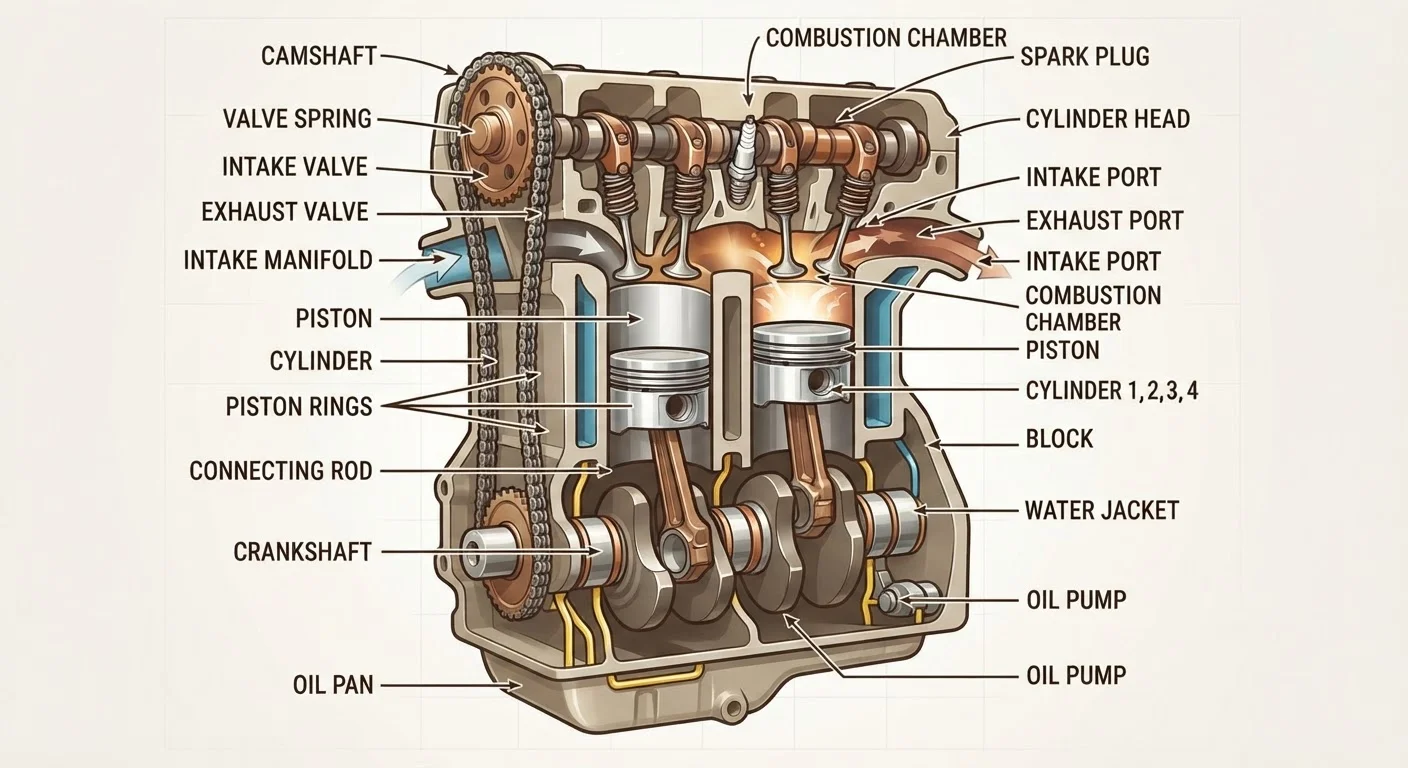
Photo credit: TheBlogZappier.com | Simple Search, Credible Results
In this article
Demystify how a car engine works, from combustion cycles to cooling systems, in plain language any driver can follow.
Key Takeaways
- A car engine converts fuel combustion into rotational motion through repeating piston cycles.
- Four main strokes - intake, compression, power, and exhaust - occur in every cylinder.
- Cooling and lubrication systems are essential to prevent engine damage from heat and friction.
- Engine displacement and cylinder count directly influence power output and fuel consumption.
- Regular maintenance, including oil changes, keeps these interconnected systems working together.
The Four-Stroke Cycle: Where Power Begins
Every time you press the accelerator, your engine runs through a precise sequence inside each cylinder. Understanding this sequence - called the four-stroke cycle - is the foundation of engine literacy.
- Intake: The piston moves downward, drawing a mixture of air and fuel into the cylinder through an open intake valve.
- Compression: Both valves close and the piston moves back up, compressing the mixture into a much smaller space. Compression increases combustion efficiency.
- Power (Combustion): The spark plug fires, igniting the compressed mixture. The controlled explosion forces the piston sharply downward - this is the stroke that actually drives the vehicle.
- Exhaust: The exhaust valve opens and the piston rises again, pushing spent gases out through the exhaust system and eventually out of the tailpipe.
This cycle repeats thousands of times per minute across multiple cylinders, which is why engines produce smooth, continuous power rather than individual bursts. For a broader look at the terminology you'll encounter when discussing these systems, see our guide to automotive jargon.
4,000-7,000
Typical engine RPM range during normal driving
RPM (revolutions per minute) indicates how many times the crankshaft completes a full rotation; most passenger engines redline between 6,000 and 8,000 RPM.
~30%
Thermal efficiency of a typical gasoline engine
Most gasoline engines convert roughly 25-35% of fuel energy into usable motion; the remainder is lost as heat, according to widely cited engineering references.
3,000-5,000
Combustion events per minute in a 4-cylinder engine
A four-cylinder engine running at 3,000 RPM produces approximately 6,000 power strokes per minute across all cylinders combined (two per revolution per cylinder).
From Pistons to Wheels: How Motion Is Transferred
The downward force of each power stroke spins the crankshaft - a rotating shaft that converts the pistons' up-and-down motion into rotational energy. That rotation travels through the transmission, driveshaft, and differential before reaching the wheels.
The camshaft works in coordination with the crankshaft, controlling when intake and exhaust valves open and close relative to each piston's position. The timing of this relationship, maintained by a timing belt or chain, is critical: if timing slips or a belt breaks, the engine can suffer serious internal damage.
Engine output is described in two key terms: horsepower measures how quickly work is done (peak power), while torque describes the rotational force available - what you feel when accelerating from a stop. Higher torque at lower engine speeds makes a vehicle feel more responsive in everyday driving.
“The internal combustion engine is one of the most complex mechanical systems ever mass-produced, yet its core principle - burn fuel, capture expansion, convert to rotation - has remained essentially unchanged for over a century.”
— Autos & Driving Editorial Team, Automotive consumer education writers
Cooling, Lubrication, and Why They Matter
Combustion generates enormous heat - far more than the engine metal could survive without assistance. Two systems work constantly to protect the engine.
The cooling system circulates a water-and-antifreeze mixture (coolant) through channels built into the engine block and cylinder head. Heat transfers into the coolant, which flows to the radiator at the front of the car, where airflow dissipates it. A thermostat regulates coolant flow to keep the engine within its optimal temperature range.
The lubrication system pumps engine oil under pressure to bearings, camshafts, pistons, and other moving parts. Oil reduces metal-to-metal friction, carries heat away, and suspends microscopic contaminants. Over time, oil degrades and accumulates byproducts, which is why regular oil changes are one of the most consequential maintenance habits a driver can build. Our article on engine oil misconceptions covers common misunderstandings about grades, intervals, and synthetic versus conventional oil.
Check These Fluids at Every Fill-Up
Engine oil and coolant levels can be checked with a quick look under the hood at the dipstick and coolant reservoir. Catching a low reading early is far less costly than addressing the damage caused by running an engine low on either fluid. Your owner's manual shows exactly where these check points are located for your specific vehicle.
Supporting Systems That Keep It All Running
The combustion and mechanical systems don't operate in isolation. Several additional systems ensure the engine starts, runs cleanly, and communicates problems to you.
- Fuel system: Delivers precisely metered fuel to each cylinder via fuel injectors. Modern engines use electronic fuel injection rather than older carburetor-based systems, improving efficiency and emissions.
- Ignition system: Generates and times the electrical spark in each cylinder. Spark plug condition directly affects fuel economy and smooth running.
- Exhaust and emissions system: Channels exhaust gases away and uses components like the catalytic converter to reduce harmful emissions before gases exit the tailpipe.
- Engine management system: A network of sensors and an electronic control unit (ECU) constantly monitors conditions - temperature, oxygen levels, throttle position - and adjusts fuel, timing, and airflow in real time.
The electrical architecture behind these sensor and control systems is explained in detail in our guide to your car's electrical system. For a practical maintenance roadmap that puts all of this in context, see our car maintenance schedule explainer.
Electric Vehicles Work Differently
Battery-electric vehicles (BEVs) replace the internal combustion engine with one or more electric motors powered by a high-voltage battery pack. They have no pistons, crankshaft, or combustion cycle, and require none of the associated fluids like engine oil or coolant for an engine block. Hybrid vehicles combine both systems, using an electric motor alongside a conventional engine.
Frequently Asked Questions

Author
Autos & Driving Editorial Team
Autos & Driving Editorial Team is the collective byline for our editorial team and contributor network. Articles published under this byline or an editorial pen name are researched, written, and reviewed according to our editorial standards for clarity, consistency, and independence before publication.
View all articles →