
Denied, Underpaid, or Disputed: Understanding Claim Outcomes
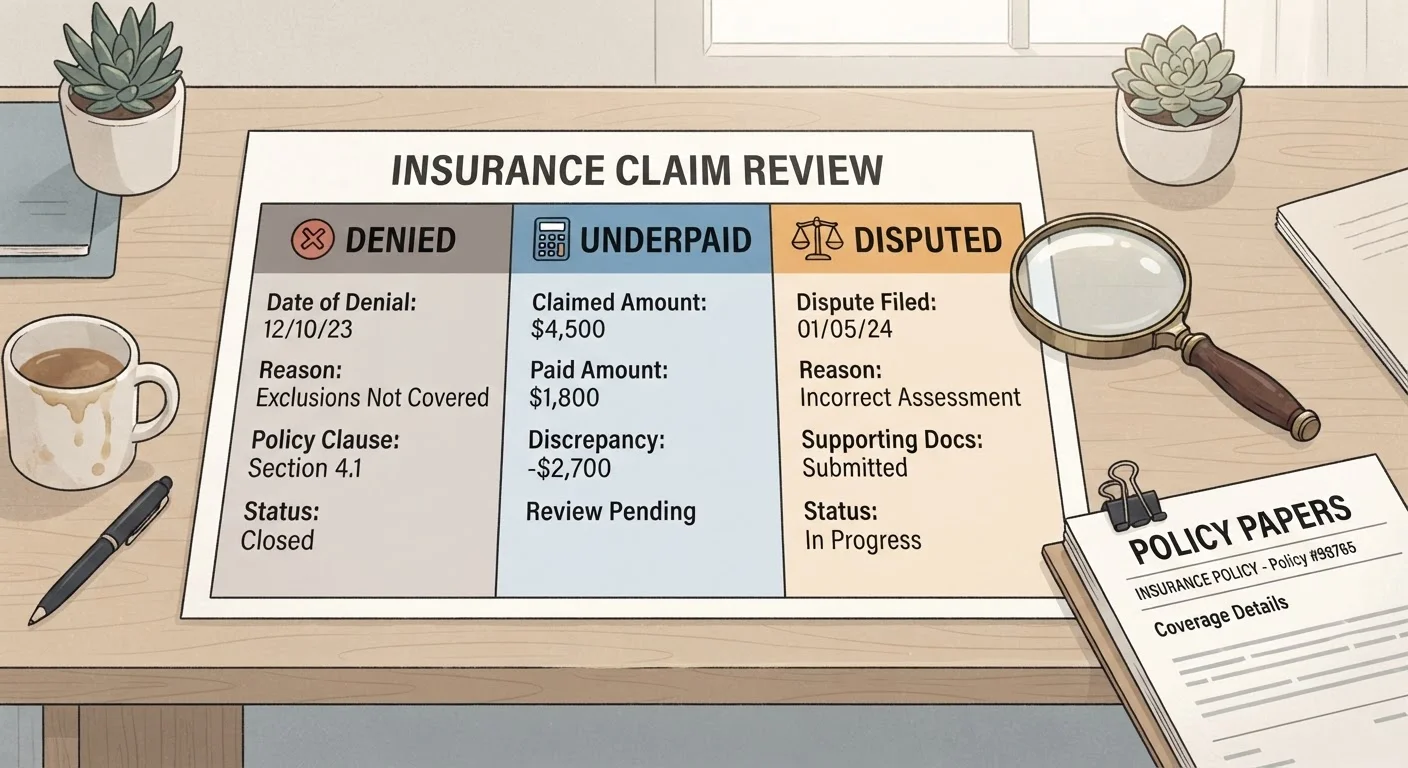
Photo credit: TheBlogZappier.com | Simple Search, Credible Results
In this article
Not every claim ends in a full payout. This explainer covers what denial, partial payment, and dispute each mean — and what options follow.
Key Takeaways
- A denied claim means the insurer concluded the loss is not covered under your policy.
- An underpaid claim means coverage was accepted but the payment amount is lower than expected.
- A disputed claim involves a disagreement — about cause, value, or coverage — that hasn't been resolved.
- All three outcomes give you the right to respond, question, or formally appeal.
- Insurers must provide written reasons for denial; you can use these to build a response.
- Consulting a licensed insurance professional or attorney is advisable before escalating a dispute.
Three Ways a Claim Can End — and Why It Matters
When you file an insurance claim, you expect a straightforward resolution. In practice, outcomes vary. Knowing the difference between a denial, an underpayment, and a dispute helps you understand where you stand and what your options are before responding.
The full claims journey — from first notice to final payment — is covered in our overview of the insurance claims process. This article focuses specifically on what happens when that journey doesn't end the way you expected.
All Three Outcomes Give You Options
A denial, an underpayment, and an open dispute all come with formal response pathways. None of them require you to simply accept the insurer's initial position. State insurance regulators exist specifically to hold insurers accountable to their policy terms and applicable law — and filing a complaint with your state department costs nothing.
Denied Claims: What It Means and Why It Happens
A denial means the insurer has determined that the loss you reported is not covered under your policy. No payment is issued. The insurer is required to provide a written denial letter explaining the specific reason — usually a reference to a policy exclusion, a coverage condition that wasn't met, or a procedural issue such as a missed reporting deadline.
Common denial reasons include:
- Exclusions: The type of loss is explicitly not covered (e.g., flood damage under a standard homeowners policy).
- Lapsed coverage: The policy was not in force when the loss occurred.
- Late reporting: The claim was filed outside the window required by the policy.
- Misrepresentation: Information on the application was found to be inaccurate in a material way.
- Lack of documentation: The insurer could not verify the loss with the evidence provided.
A denial is not necessarily the final word. You have the right to appeal, and understanding the stated reason is the critical first step. Our detailed guide on appeals and dispute resolution walks through how that process works.
Underpaid Claims: When Coverage Is Accepted but the Amount Falls Short
An underpaid claim — sometimes called a partial payment — occurs when the insurer accepts that a covered loss happened but calculates a payout lower than what you believe you're owed. Coverage is not in question; the dollar amount is.
Several factors commonly reduce claim payments:
- Deductibles: Your policy's deductible is subtracted from the gross loss amount before any payment is issued.
- Depreciation: Policies that pay actual cash value (ACV) rather than replacement cost value (RCV) will reduce the payout to account for the item's age and wear.
- Coverage limits: If your loss exceeds your policy limit, the insurer pays only up to that cap.
- Adjuster valuation: The insurer's estimate of the repair or replacement cost may differ from contractor quotes or your own assessment.
If you believe a payment is too low, you can submit additional documentation — such as independent contractor estimates — or file a supplemental claim. Understanding how settlement amounts are calculated in the first place can help you evaluate whether the number is reasonable. See our explainer on how claim settlements are calculated for context.
Ask for an Itemized Payment Breakdown
If you receive a payment that seems lower than expected, ask your insurer for a line-by-line breakdown of how the amount was calculated. This will show exactly where depreciation, deductibles, or coverage limits were applied — and reveal which figures are most worth challenging. Many policyholders don't realize they can request this level of detail.
Disputed Claims: When the Disagreement Is Still Open
A dispute is an active, unresolved disagreement between you and your insurer about some aspect of the claim. Unlike a denial (where a decision has been made) or an underpayment (where payment has been issued), a disputed claim is still in motion. The disagreement may concern:
- Whether coverage applies to the specific cause of loss
- The dollar value of the damage or loss
- The scope of necessary repairs
- Liability in auto or liability claims
Disputes can be resolved through several formal mechanisms depending on your policy and state:
- Internal appeal
- A formal request to the insurer to reconsider its position, reviewed by someone not involved in the original decision.
- Appraisal
- A process built into many property policies where each side hires an independent appraiser, and a neutral umpire breaks any tie. This resolves valuation disagreements but not coverage disputes.
- Mediation
- A voluntary, non-binding process with a neutral third party who helps both sides reach an agreement.
- State insurance department complaint
- Filing a complaint with your state's regulator. This triggers a review of whether the insurer followed state law and its own policy terms.
- Litigation
- If other avenues fail, legal action is an option — though it is typically time-consuming and costly.
For a thorough look at how delays can compound disputes, see why claims get delayed and what you can do.
What to Do When Your Outcome Isn't What You Expected
Regardless of whether your claim was denied, underpaid, or is stuck in dispute, the same core steps apply:
- Read the explanation carefully. The insurer's written statement is your starting point. Identify the exact policy language cited.
- Gather your documentation. Collect photos, repair estimates, receipts, correspondence, and any third-party assessments that support your position.
- Request your claim file. You generally have the right to see the insurer's full file on your claim, including the adjuster's notes.
- Respond within any stated deadlines. Policies and state laws impose time limits on appeals and disputes — missing them can limit your options.
- Consult a professional if needed. A licensed public adjuster, insurance attorney, or your state's insurance department can help evaluate whether the insurer's position is sound.
It's also worth reviewing common misconceptions about insurance claims — some assumptions about how insurers must respond turn out to be incorrect, and clearing those up can save time.
This article is for general informational purposes only and does not constitute legal, financial, or insurance advice. Coverage terms, exclusions, and dispute procedures vary by policy and state. Consult a licensed insurance professional or attorney for guidance specific to your situation.
Frequently Asked Questions

Author
Insurance Basics Editorial Team
Insurance Basics Editorial Team is the collective byline for our editorial team and contributor network. Articles published under this byline or an editorial pen name are researched, written, and reviewed according to our editorial standards for clarity, consistency, and independence before publication.
View all articles →